Friday, January 30, 2009

The Friday Abstract: Not So Abstract

Unlike the standard friday abstracts, where I entertain my readers with a bit of the bizarre, I will break with friday abstract tradition this once and bring you an update not so abstract in nature.

Today marks my second full week at my new job. While McGill University remains a familiar environment, having worked there previously, much has changed, at least much as changed in regards to what I have been assigned to do.

I'll save the details about work for another blog post - as soon as I make the time to sit my butt on a chair and command the guy in my head that does most of the heavy word lifting to start hammering a few more words to form a coherent blog post.

If you follow me on Twitter (if not, here I am @dkemper), you have probably noticed a slight slowdown in tweets, which I guess you all know is to be expected. However, unlike other times, when work so radically altered my scheduling I barely blogged regularly, this time I shall endeavour to make the time to maintain an active and consistent online and social networking voice.

Ironically, I have been very active with my Archives*Open Twitter feed (if you're still not following Archives*Open on Twitter, now is your chance, @archivesopen). As I mentioned in a previous blog post (Holy Twitter Tweets, Batman!), I am rethinking the future direction of the Archives*Open blog. I am not yet sure how to proceed.

To that end, I am still working diligently on the Archives*Open Twitter feed, tapping into the power of search and RSS feeds to automatically send archives-related news, articles and blog posts through Archives*Open's Twitter feed.

I am also participating in other ways. I am monitoring the Archives*Open Twitter page when I get the chance and connecting with more archivists and records managers on Twitter. The number of connections being formed and the rise of community is wonderfully surprising to me. I love it when archivists get together and tweet! You guys and gals are awesome!

Well lookee here. I never expected to write a whole bunch. But dog gone it, I just did.

Perhaps the little guy in my head who does all the heavy word lifting is more ready than I thought.

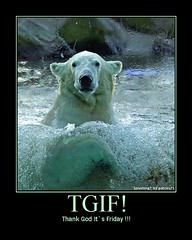
For now, thank God it's Friday. TGIF.

Photo credit: patries71

Sunday, January 25, 2009

Saturday / Sunday Slide: Smurf Shoe

Discovery. It is always illuminating and satisfying to discover something new, particularly new music, which is something I am almost constantly seeking. Thanks to Twitterer @bizaaron for tweeting about Freescha, an indie-electro duo based in San Fernando Valley, California.

Listen to this little ditty called Smurf Shoe. It is difficult to tell if this is an official music video or a fan-created video. Admittingly, the video is strange - in a good way, though.

One thing is certain: If you ain't shakin' your rump by the end of the video, check your pulse.


Saturday, January 24, 2009

What does President Obama and I Have in Common?

Guess?

Give up?

This was our first week on the job.

(Hence the lack of any new blog posts here.)

Friday, January 16, 2009

Holy Twitter Tweets, Batman!

Twitter

After the Twitter bird feathers settled following my blog post on the 15 People All Archivists Must Follow On Twitter, I felt that I, make that, we--and by we I mean readers of this blog and Twitter users now following one another--had accomplished something close to a major milestone. We created a small but vocal and flourishing micro-blogging community.

Granted, I realize that many among the list do not always tweet about archives, archivists, or pressing archival issues (in that regard, I am probably the biggest practitioner of impractical tweets), but there is a sense of shared interests, which I am certain will bear fruit in the weeks and months ahead.

Moreover, by testing Twitter, many of us are now not only talking the Web 2.0 walk, but walking the Web 2.0 talk [thanks pakurilecz-dk], building and gaining real-world experience. What works. What doesn't.

It's true, Twitter can be addictive, like cigarettes. A potential time-waster, if used without discipline. But Twitter, simply put, is a nimble, mobile, light-weight publishing tool! Nothing comes close!

Twitter may change in a year or two. Another service may appear on the horizon. But what remains in the constant flux of technology evolution, and what will always remain, is our humanity: People want to create, communicate, share, and participate, and they will use these social technologies.

Reinvention: New Job

No, that's not a typo or a misprint, nor are you hallucinating. I found a new job. The telephone call and the official offer documents arrived mid-week and so therefore I can make the announcement here. I was offered, and accepted, a position at McGill University.

This position marks my return to the university, where I studied and received my MLIS and worked in the University Archives for several years.

This time, I will be working under the Information Technology Services banner, focusing on managing digital content and enabling collaboration among University units. It's a step in a new direction, one requiring, I feel, a Kierkegaardian kind of faith. Expect a slowdown in blog posts in the coming weeks, though a few pithy tweets are not entirely out of the question.

Archives*Open (perpetual beta)

When I launched Archives*Open back in early December, I was inspired and energized and greatly encouraged by the positive feedback and comments.

Today, I still feel inspired and energized. But now, with a new job starting imminently, I wonder if I can honestly maintain energy levels.

I hate to see a bright idea dim.

So in an effort to keep things moving I am making Archives*Open more, well, open, leveraging tools, technologies and services that are freely available on the Web to push content to the blog - with some editorial assistance on my part.

For example, I have started using a Twitter service called Twitterfeed, which takes RSS feeds (title and description fields only) and tweets them to a Twitter account. Regarding the Archives*Open twitter feed (@archivesopen), I am creating search parameters that encompass archives, access and Web 2.0 and saving them as RSS feeds and then running them through Twitterfeed to the @archivesopen Twitter account.

I have done something similar with Delicious, the social bookmarking service. Every time I find a website that fits 'the Web 2.0/innovative access to archival materials' classification, I tag it with "archivesopen" (no quotation marks, natch) and in time the bookmark (short blurb and URL) will be tweeted.

You can join in as well.

If you have a Delicious account, you can tag websites with "archivesopen." Fingers crossed, the bookmark will be tweeted via the Archives*Open Twitter feed.

Upwards and onwards. Stay tuned.

Photo credits comicbasecarrotcreativeSuviko

Tuesday, January 13, 2009

15 People All Archivists Must Follow on Twitter

UPDATE: 15 and counting. More names being added. See below.

Whether you are new to Twitter, or a veteran of the popular social networking and micro-blogging service, there is one thing that almost all of us at one time another focus on: finding and following people.

Like most social networking websites, the long-term value of Twitter is attained through participation and community. With Twitter, participation is easy. Open an account and send out your updates (or tweets) in 140 characters or less. To find and follow people (community) who share your interests and from whom you can learn, personally and professionally, however, is a little more difficult, as it is not always clear on Twitter what are people's professional identities or interests.

To remedy the situation, I have done some digging around. Inspired by Darren Rowse, who started a timely blog aimed at Twitter beginners called Twitip, I have collected a list of fifteen people all archivists must follow.

If you are an archivist or interested in archives and archival issues, these fifteen people should become part of your follow list.

9. @amycsc 
11. @caturday 

Do you have other Twitter people to suggest? Send me a tweet at @dkemper or to @archivesopen! Want to get started with Twitter, sign up here.

UPDATE (13/01/2009)

@souslapoussiere - French/English

UPDATE (14/01/2009)


UPDATE (15/01/2009)


UPDATE (24/01/2009)

Monday, January 12, 2009

Interesting People, Interesting Blogs (Part 12)

This is the first installment of the new year of the much beloved blog post series called "Interesting People, Interesting Blogs," a place where the editor of The DIGITAL Archive (ahem, me) carefully examines and scrutinizes blogs and honours one for being very interesting.

For this installment, I have chosen "The Posterity Project," a blog written by Gordon Belt, an information professional with a background in special libraries and archival administration who is based in Nashville, Tennessee. According to Belt, The Posterity Project is

a blog chronicling news and issues related to archives, history, civic responsibility, and open access to public records, with reflections on archives and history in the "Volunteer State" of Tennessee.

I chose this blog for three reasons:

1. The impressive volume of timely and quality content

Impressive volume is an understatement. Belt writes prolifically on archives matters and links extensively to other websites. My personal favorite is the Weekly Roundup, where he cites interesting tid-bits from newspaper articles, blog posts, and websites. At times, The Posterity Project blog seems to transcends the usual blog formatg and becomes more like a large resource center.

2. Clean layout and design

With so much content, one would believe a blog would soon become a disorganized mess, but Belt manages to keep his layout clean and streamlined, a difficult feat considering some blogging platforms. (Cough, blogger, cough.)

3. Highlights the value of regional blogging

While The Posterity Project covers historical and archival stories and issues from across the United States and beyond, Belt makes a solid effort in showcasing local and regional historical and archival resources in his home state of Tennessee. One impressive feature incorporated in the blog (which should be emulated by other blogs, in my opinion) is the use of Google Maps in displaying an interactive map of archives in the state of Tennessee. Very well done. I hope other historians and archivists in Tennesse (and elsewhere) are reading The Posterity Project.

Photo credit kevindooley

Friday, January 09, 2009

The Friday Abstract: Uncle Jay Explains the News

Yes, it's true, my Uncle Jay explains the news. Well, actually, Uncle Jay is not really my uncle, nor is he related to my family in any shape or form. I just found him on YouTube. Actually, I found him on a website that someone had recommended for a completely different reason. And the person responsible for that website had embed this video and I thought, Voila, I found this week's Friday Abstract. It that clear?

Oh, never mind, the Friday Abstract is served!


Thursday, January 08, 2009

Ready, Set...Those New Year's Resolutions?

Happy New Year DIGITAL Archive readers! It's a little late, true, but, you know, better late than never, right.

So, what are your new year's resolutions? No, seriously, what are they? We've all made some, loudly or secretly. This time around, however, let's avoid those long lists of resolutions that so often (I'm at pains to say it) fail miserably.

Social media and technology expert Chris Brogan wrote a thoughtful post on new year's resolutions - and how to achieve them. First off, he doesn't make any; rather, he selects three words that help him define goals for the year ahead.

3 Words to Achieve Goals in 2009

Brogan clearly and logically explains the potential and power of selecting three words to set goals for 2009. Unlike traditional New Year's resolutions, which often push us, mostly reluctantly, towards a set of goals, the three keyword technique pulls us toward those goals. Their hope inspires us to achieve them. So how do we set those three keywords? Brogan offers this advice:

Look for three words that will help you frame your challenges and opportunities for 2009. Don’t think about where you are this exact moment...Try setting your three words far out on the horizon, but such that they can lead you to your goals every day.


Nice Stuff. But I'm Stuck!

As hard as I tried, I could not come up with even one word. But then, serendipity stepped in to the picture in the form of an email from a friend. In his email he wrote: Work. Freedom. Enlightenment. I kid you not. Perhaps he had read Brogan's blog post. I don't know. But what I do know, these three words sound perfect to me.

Work.

In these difficult economic times, I believe most adults fall into one of the following categories: employed and satisfied, employed but fearful of losing their job, and plain and simple unemployed and discouraged. If you fit in either of the latter two categories, I, in those immortal words, feel your pain. Seeking work in these times is hard work. Period. But let's use this keyword to inspire us, to pull us towards our goal. Work. Let's see. What kind of work? Let's step it up a level: What are you passionate about? It often said, but so true. What are you passionate about? Whatever it is, I am certain it will propel you through these difficult economic times.

Freedom.

Year after year, we drag chains that are latched to bad habits. We drag chains latched to negativity. Sour moods. And so on. These chains weigh us down and weigh down our productivity - and, worse still, weigh down our goals and dreams. What is the solution? Freedom. But to achieve freedom we need action. We need to take appropriate, effective, and resolute steps to achieve freedom from those chains that hold back. Objectively and often swiftly, we need to create plan and set it into motion.

Enlightenment.

This one is a touch vague and open to interpretation, which could be a good thing. From my perspective, the pursuit of enlightenment is about seeking wisdom from sources that we may have overlooked previously, such as those around us who are smarter and wiser than us. It also is about listening to understand rather than talking and wanting to be heard. It also is about quiting the mind in order to hear that still, small--and usually incredibly knowledgeable--inner voice.

Work. Freedom. Enlightenment. This is not another blog post. This is something I really want to pursue. Consider this a record of my decision.

Set your 3 words for a successful 2009!

Photo credit Harpagornis

Saturday, January 03, 2009

Just Tweet It: The Twitter Song

Just Tweet It
(inspired by Michael Jackson's "Beat It" and Twitter, of course)

They told him don't you ever blog around here
Don't wanna read your posts cuz they're never clear
The time is passing fast and you better be sincere
So tweet it, just tweet it

You better tweet, under 140 characters if you can
Don't wanna see no long blog post, don't be no literary man
You wanna be followed, better follow others while you can
So tweet it, but you wanna just blog

Just tweet it, tweet it, tweet it, tweet it
No one wants to be deleted
Bloggin' all long and rough is not bright
It doesn't matter, left-wing or right

Just tweet it, tweet it

UPDATE: The Youtube link to Michael Jackson's "Beat It"

Wednesday, December 31, 2008

2009 Predictions

It's December, it's almost the end of the year, and it's time, once again, to pull out the old crystal ball from the closet, dust it off, and gaze into its murky prescience to see the future as it relates to technology trends and the Web.

Location-based information and services
The rise of GPS and GPS-enabled devices such as the iPhone will propel location-based information and services. While large search engines such as Google are good at finding information from all over the place, they tend to lack the location-based results that we so often need. Expect microblogging to play a role in this sphere.

Location-based content writers, curators
When location-based information and services explode, there will be a need for people--writers and curators--to supply the increasing demand. Subject matter expects and locality experts get active.

Cloud computing (cumulus vs. cirrus clouds or local vs. global)
With Google storing our email, documents, photos and whatever else on its servers, the cloud computing concept and reality are expanding. In many ways, we do not need hard drives to store our files. I predict cloud computing will expand into two areas: local and global or cumulus and cirrus. Low hanging clouds (cumulus) could store the files and apps of small companies, while high clouds (cirrus) could store the files and apps of large or global-sized operations. Once again, I predict Twitter and other micro-blogging tools with develop their own local and global presence, with local focusing on specific groups and global on large, diverse groups (kind of like Twitter).

End of Free
There are many, many free services on the Web - but do any them have a revenue / business model? No one--not even I can argue--with free services, but I predict there will be an end to free. Will Twitter charge a fee, will Second Life, will wikis, etc - I don't know. But expect some serious talk about this in 2009.

Video Video Video
When I think about video, I think excellent education tool. The mumbo-jumbo gonzo videos will always be around on YouTube, but I predict video's educational power will increase its presence.

Collective Build (tm)
The Collective Build (my own little theory) is something I've been thinking about for several months. With all the stuff we're blogging, micro-blogging, podcasting, mapping, communicating, collaborating, community-making, we are building something that I am calling the Collective Build. We're building something huge, and as the tools and apps become more sophisticated, this people-powered, social-fueled Collective Build will start to take shape in 2009.

You've been warned.

Happy New Year, Dear Readers. Thanks for visiting.

Tuesday, December 30, 2008

Whoa, Nelly! What Will Tech Look Like When We're 90?

During the Christmas holidays, I visited family and friends; like most of you, our family and close friends came together, prepared a large meal, talked about the past year, and, of course, exchanged gifts.

Among those celebrating with us was a short, spunky, Scottish lady named Nelly. Real name Helen, Nelly has one of those rare energy levels that prompt her to hug and sometimes (if the music is right) dance with those around her. Nelly is a bundle of energy. Why else would friends call her Nelly rather than Helen. Nelly, by the way, is 92 years old.

While the gifts were being unwrapped, I pulled out my two digital cameras (a Kodak EasyShare and a HP Photosmart) and began to shoot those candid moments when surprise turns to happiness (or dismay) as family and friends opened their gifts.

In the process of shooting, Nelly looked at the cameras with amazement. She asked to look at one of them, and so I showed her a camera and the viewfinder, which showed her the pictures I had just taken. She shook her head in astonishment. When I removed the 2GB SD memory card from the camera and told her that all the pictures were stored on this tiny little device, I was afraid she would fall off her chair.

When I slipped the SD Card into a nearby laptop's memory card reader and showed her the pictures and printed out a few, she look intently at the images and said with the wisdom of ninety plus years of life: "Aren't they just beautiful pictures. Aren't they just full of memories."

While the technology amazed her initially (the advancements in digital photography, the shrinking size of storage devices, the ease to print photographs), she ultimately understood the real meaning behind the technology: It made picture-taking and sharing (and memory-making) more immediate. The human side trumped the technology insomuch that technology simply made the human experience among family and friends (the picture-taking process, for instance) more intimate, more immediate.

After the evening ended, I thought about those moments and wondered how technology will look like when we're 90 years old. It will certainly amaze us as well, I am sure. I cannot even begin to imagine.

But we can be certain of one thing: Technology will continue to enable us to communicate, create, share, and bond (form communities) with others. How will all this transpire, I can only guess.

What are your ideas - what will technology look like when we hit 90 years old (God and good genes willing.)

Sunday, December 28, 2008

Saturday / Sunday Slide: The Daydream

I discovered a gem of talent over the Christmas holiday: San Francisco-based ambient musician and artist Tycho (real name Scott Hansen).


Check out his music here and his art porfolio here.

Thursday, December 25, 2008

Merry Christmas

Hello Readers,

Just wishing you all a very Merry Christmas, Season's Greetings, Happy Holidays, and a Happy New Year.

Your blogger in arms,

the DA

Tuesday, December 23, 2008

One Meme to Rule Them All

There are memes, and then there are memes. A meme is a kind of chain letter for the blogosphere without any nasty curses or an overwhelmed inbox of chain-emails, as Walt at Random explains. Someone tags you or serves you a meme and you respond, in turn, following a set of rules.

I have one meme I am working on (I haven't forgotten you, Oza). But I also served myself with a meme, right in time for the new year:

List 15 things you want to do or want to achieve in the new year, even if they sound improbable or unlikely.

Try it, if you like, and let me know what you wrote. Here's what I came up with:

1. Attend the launch of a Space shuttle.

2. Fly to the UK, run across the countryside, and fly back home.

3. Meet at least one interesting person each day and learn something new each day

4. Write a book, or several, and give talks around the world to inspire others

5. Read more.

6. Make music.

7. Participate in something greater than myself.

8. Live boldly and authentically.

9. Sleep soundly at night and wake up energized and alert at 6 am.

10. Find a cool gig on a sunny campus in California next to the Pacific Ocean.

11. Dip my fingers in the Pacific Ocean. 

12. Meditate.

13. Rest the mind and work the body.

14. Travel to Asia.

15. Make awesome memories.


A few weeks ago, I was served a meme by local Montreal blogger Oza Meilleur, who blogs at Oza Meilleur (the making of), but, unfortunately, I still have not started working through it.

While I was thinking about Oza's meme, I started toying with an idea for a new meme, which was partly inspired by a blog post I read on David Lee King's blog. King, who blogs at, er, at David Lee King, is a librarian, musician, writer, blogger, and videographer and seems like a very nice guy. He loves his job and shares his joy through his numerous social networks.

King's meme, or the one he had been served, has something to do with 99 things: Things you had done, things you want to do, and things you have not done and don't ever want to do.

I thought about it, and found myself focusing on things you want to do. That particular one seemed full of possibilities, it was hard to resist.

Monday, December 22, 2008

Doing Business in Second Life: Is Your Digital Archive Open for Business?

When I worked at the International Monetary Fund (IMF), I learned about a project developed by the World Bank Group called Doing Business, a five-year old project that reviews and ranks government and local business laws and regulations in over 180 member countries and determines which are the best for doing business.

According to the Doing Business blog, which is written by World Bank staff, the World Bank believes that "encouraging business is key to creating jobs and alleviating poverty."

A part of the Doing Business project that caught my attention was that the World Bank had created a virtual community in Second Life that supports the objectives and goals of Doing Business but in a virtual environment. While Doing Business is primarily a real world project, the World Bank is attempting to recreate its success in the virtual realm. In October 2008, the World Bank held its second virtual Doing Business meeting.


At the time, my IMF colleagues were considering whether or not Second Life could play a role in IMF activities. While plans were made to review Second Life further, I started wondering if virtual worlds and virtual communities could have a role in archives.

For those unfamiliar with Second Life, Second Life (or SL) is:

a 3-D virtual world created by its users, also known as residents. Since opening to the public in 2003, it has grown explosively and today is inhabited by millions of residents from around the globe. It offers a platform for communication, business, and education.

Let me know what you think. Archivists in Second Life???

Friday, December 19, 2008

The Friday Abstract: Don't Fear the Archivist, er, the Reaper

I usually do extensive research and perform mental calisthenics to write The Friday Abstract. But, alas, today, I have a fever and the only prescription is more cowbell!

From Saturday Night Live - "More Cowbell"


Tuesday, December 16, 2008

The Self-Interview: Tabloid Edition

TABLOID Reporter: Dave? Dave?

Dave: What the--? I'm sorry, but I really have no time for this. I have to catch my bus.

TABLOID: A few questions for the scandal sheets...enquiring minds want to know...

Dave: I normally don't talk to tabloids...

TABLOID: Whatever...You recently launched a third--yes, a third--blog. The question everyone wants answers to know is: Are you out of your mind? Three blogs? How are you gonna handle the pressure?

Dave: Out of my mind? No, of course not. Each blog serves a particular purpose. Arch.i.vi.us, for example, pretty much runs on its own. Not much intervention on my behalf. Just a few tweaks now and then. Thankfully, the blog remains a very good resource. I find something interesting there every day because the content it aggregates is always fresh and relevant.

TABLOID: Horrendous shameless plug. Now what about The DIGITAL Archive? Will your cornerstone blog be tossed to curb like your long line of ex-wives?

Dave: I cannot believe I am hearing you say these things. No, The DIGITAL Archive will remain online as long as its writer has something noteworthy to share.

But at the moment, what I am most proud of is my latest blog venture called Archives*Open, a blog that focuses on how archivists are using technology, particularly Web 2.0, to further enhance and improve public access to and understanding of archival material.

I hope to cultivate a collaborative team spirit with this blog, whereby other archivists can submit their Web 2.0 archival projects that they have recently launched or--and here's a big scoop!--they can submit their own thoughts and comments on Web 2.0 and Archives.

TABLOID: Major scoop! Archivists can also submit their opinions on Web 2.0 and Archives?

Dave: Yes, that's a new plan in order to make Archives*Open a more community-oriented, collaborative space. I welcome input. How would archivists use Web 2.0 in their archives? What Web 2.0 technologies, tools, or ethics would they want to implement, and why? I think it could generate some interesting discussions.

TABLOID: Wait a minute! Wait. One. Minute! Archivists and Web 2.0? You've got to be kidding me?! I bet half of them don't know what Web 2.0 is and the other half who do know want nothing of it!

Dave: I refuse to sink to such levels of cynicism. I know archivists are cautious professionals, analyzing the situation before committing themselves or their limited resources. That's smart. I mean, heck, I think we as a community are still figuring things out in regards to Web 2.0. This is all new stuff! But exciting new stuff, stuff that could change things for the better.

I believe Web 2.0 is a win-win situation, if we are willing to take a few calculated risks. Web 2.0 is not only about technology, it's also about thinking differently, looking at things differently. For Archives*Open, it's about thinking differently about access to archival materials. It's all about giving access to the masses in innovative ways!

TABLOID: Ugh! You have to work on your marketing skills. Listen. I'm still not convinced. I think this Web 2.0 is essentially a fad, like Facebook and Twitter.

Dave: Platforms, like the ones you mentioned, will indeed change or disappear and re-appear with a different look. But the key is what they fulfill: They fulfill the innate human desire to communicate, connect, and build communities. Didn't Seth Godin write a book called Tribes: We Need You to Lead Us, about people's desire to form and join a movement, an idea--something along those lines?

TABLOID: OK, Socrates! You're losing me here!

Dave: Nevermind.

TABLOID: So Archives*Open is open. That's wonderful news. Great. So much for if it bleeds, it leads.

Dave: Is the interview over then? Are we done?

TABLOID: One last question!

Dave: No more, please. Out of my way.

TABLOID: Dave! Dave!

Dave: Yes! Yes! I'm right here!

TABLOID: Is it true you dumped Jessica Alba for Jessica Biel? And what's with your obsession with Jessicas anyway?? Hey! Come back! You can't run away...you can out run me but you can't out run the paparazzi!


From time to time, I interview myself. I conducted a self-interview a few months ago which went quite well. It was a sit-down interview, one-on-one with myself across a table on a dimly-lit set with questions and answers in the spirit of an investigative Mike Wallace or a probing Charlie Rose interview.

This latest self-interview, however, was different. I don't know what happened to the previously dignified journalist; he was gone, replaced by some kind of uncooth tabloid reporter, the type who snakes around your favourite watering hole, waiting for you to spill some saucy bit of gossip.

But since I do not drink, I was accosted right outside the The DIGITAL Archive office. Confused and unprepared, walking while talking, I had to react as best as I could when his mic sprung up in my face.
Saturday, December 13, 2008

Saturday / Sunday Slide: BBtv Interviews the (other) Digital Archivist

Boing Boing, the technology and tech culture blog, recently interviewed a human rights digital archivist on its sister video website Boing Boing TV (BBtv, for short).

Popular tech writer Xeni Jardin interviewed WITNESS.ORG's Grace Lile, the human rights' organization's digital archivist in charge of organizing and preserving institutional and user-submitted human rights videos and images.

I mention this piece because I was surprised and pleased to see such an influential blog as Boing Boing mention the importance and necessity of a digital archivist in our digital information age. 

Moreover, I was equally surprised and pleased to hear Ms. Lile talk about raising awareness about human rights issues and its history; engaging the public; and soliciting the public to participate online by submitting stories and videos to Hub, an experimental website designed to be a "global platform for human rights media and action."


UPDATE: Grace Lile added a comment and provided the URL to WITNESS' Media Archive Blog.

Thanks, Grace. Check it out.

Friday, December 12, 2008

The Friday Abstract: Dee Dee Does Derangement and Description Webcomic

Today, a reader name Dee Dee kindly emailed me some abstract-worthy information that spoke about her foray into the Webcomic scene.

She has created a blog-turned-webcomic about archives. Not too many of those around, which was enough proof for Dee Dee to start one of her own.

The webcomic is called Derangement and Description whose tag line reads: "A crazy little archives webcomic."

In the About section of her webcomic/blog, she explains: "Couldn’t find any webcomics about archives, so I decided to start one. I hope you enjoy reading it as much as I enjoy making it! Many thanks to Dee Cee, who tells me which of my crazy ideas would make good comics."

The Friday Abstract: Where we strive to uncover the abstract so you don't have to!

Thanks, Dee Dee. (Psst...that's her on the right!)

Sunday, December 07, 2008

Archives*Open is Open

I hope I sparked interest with last week's teaser blog post and the teaser tweets I scheduled and sent out throughout the weekend announcing the launch of Archives*Open, a new community-powered blog that focuses on archives, access, community and the Web. It is my--well, actually, our--contribution to Archives 2.0.

Giving Access to the Masses

Archives*Open, whose tag line is "Giving Access to Masses," is a platform for archivists and other professionals in the field to share and promote their Web 2.0 archival projects that focus on 'giving access to the masses,' and in so doing, inspire others who may be considering embarking on similar projects and raise awareness around the community.

I hesitate to write a 'definitive' definition of what is Web 2.0 since it incorporates so many technologies and so many values and ethics. So let's sum it up this way: Web 2.0 (and by association, Archives 2.0) is about using current and emerging Web technologies in innovative ways that focus on providing the public with a more personal, interactive, and social experience with archival materials.1

If you are working on a similar project, it's real easy to share your success stories (or almost got it right attempts): Visit Archives*Open, leave a comment with your name (personal or corporate), project title, brief project description, and a URL. That's all. I'll collect as many as I can on a weekly basis and post them on a weekly roundup blog post.

Furthermore, Archives*Open is a platform to discuss Web 2.0 technologies (blogs, wikis, podcasts, RSS, social networking, social media, etc) and Web 2.0 ethics and values (communication, conversation, participation, relationshipts, transparency, etc) and their impact on the emerging and evolving Archives 2.0 paradigm, which is being talked about constructively and critically in the archival blogosphere.

The Story Behind Archives*Open (for those really, really interested)

The seed for this blog started in late summer of this year (2008) when I was reflecting on my career in the field so far (a kind of reflection kindled by an uncertain future and, ahem, unemployment).

I found myself focusing on--and subconsciously building a new blog around--those areas that I had found most fascinating in the archives and to which I could add a solid voice of experience, knowledge, and enthusiasm.

That area is the area of creating, building, and providing improved, interactive and enhanced access to archival materials using current and emerging Web technologies.

I almost always found personal and professional satisfaction when a project such as an online virtual exhibit, online photo gallery of digitized photographs, or a large-scale portal project was launched and the public was given access to archival materials and responded with keen interest and appreciation for history and our shared stories. I was satisfied, but I knew there were more stories to share and more innovative and engaging ways to tell them.

When self-criticism struck the idea of starting a new blog, I started to doubt. I really did not want to create another soap box blog. But then the many voices in the archival blogosphere began writing more about Archives 2.0 in concrete terms - and the archival community seemed to be embracing some of the technologies and values that were defining Web 2.0. Thanks to them, and now for them, I set aside doubt and proceeded.

While I momentarily thought about converting this blog, The DIGITAL Archive, into something that would suit the needs of what is now Archives*Open, I decided against it because I felt I had established on this blog a satisfactory mix of news, comments, opinions, and observations. And my two readers would have been furious if I had changed formats yet again!

With Archives*Open, I wanted to build a more focused blog that is collaborative and community-driven, meaning that the content would come from both the writer and the community. And by more focused, I wanted a blog with a focus on access to archival materials.


Footnote

1. ArchivesNext has a list of examples of existing archives/Web 2.0 type projects and websites.

about the author

I am an information professional, researcher, and writer with over eight years experience in the information services field with experience in information and communication technology.

I have a B.A. in History and a Master's in Library and Information Studies and working on a Web and Multimedia Design certificate.

I believe that empowering people with information can enrich lives and transform the world.