CREAK!! HTML.....HEAD......TITLE.....
CREEEEAAAK!! #container {width: 770 px...
You hear those rusty web design gears turning? I sure did since starting a new web re-design project at one of McGill's affiliated teaching hospitals (part of the super-hospital entity known as the McGill University Health Centre (MUHC)).
All last week they were slowly turning and shedding bits of rust in my head as I sat down I talked with the head librarian of the Medical Library and reviewed his website plans.
I will need to give myself a few days or even a few weeks to become re-acquainted with the technicalities and peculiarities of HTML and CSS.
Still, I cannot help but sense that same feeling, which prompted me to leave my previous job, slowly stirring in my gut, cautioning me that this project is but a pit stop on the highway I have chosen to take. This highway, unfortunately, has no Google Map available. It's just the road ahead.
Please note the bottom right column, where I have stationed a neat-o del.icio.us bookmark module. Keep an eye on as I continue to bookmark relevant digitization news that I come across.
Also, please check out archi.vi.us, my attempt at creating a social bookmarking blog about all things Archives 2.0 (yeah, I'm adopting the lingo, Web 2.0, Library 2.0, etc).
Archives 2.0? It's about digital archiving, digital preserving, digital collecting, digital sharing of archival information. It's a work-in-progress, so bear with me if updates over there are slow and far between.
Saturday, March 25, 2006


Wednesday, March 15, 2006
Job Search Update
Thankfully, I will not have to dwell for much longer in this state of unemployment, which started back on March 3 when I decided to resign from my position in the McGill University Archives.
To make a long story short, I received a phone call a few weeks ago from the head librarian at one of McGill University's affiliated teaching hospitals in downtown Montreal. The head librarian, with whom I did some volunteer work in 2004, is re-designing the library websites under his direction, and he proposed a temporary contract position for me to analyze and evaluate the websites' current information architecture and then develop a newer, more flexible architecture along with a better navigation system and a cleaner design and layout.
I accepted and will start on March 20 (quite an auspicious date, considering I know of more than one person starting anew on this date as well), and I will be dividing my time between the hospital and home. In both cases, I have a respectable set up to run the necessary Web software applications such as MS Word, Dreamweaver, and Photoshop.
Fortunately, I will not have to dust off my college-level Biology 101 text books or earn a certificate in health informatics - his staff will be working on the content. But I will need to dust off my HTML and CSS text books, although nowadays it is XHTML\CSS, with CSS not only handling formatting but page layout as well.
Anyone know of a good CSS layout book, tutorial, or online resource?
It has been close to 2 weeks since I resigned, and I have been trying to focus on the proverbial long-term career plan, but all to no avail. I will take this new and very different job opportunity to open up more doors, more so in my mind than literally. Friends and colleagues have told me to rest my mind and not to jump into anything too quickly. I'll try to follow their advice.
Meanwhile, stay tuned - the DIGITAL Archive is working behind the scenes at the moment, tightening up a few gears and adjusting the vertical and horizontal controls.
We'll be back on the air soon.
Thursday, March 09, 2006
Top articles of 2006 (so far)
According to the RLG bloggers at hangingtogether.org, the following are some of the best articles written on the topics of digitization, digital preservation, access, etc.
In no particular order, here they are:
In no particular order, here they are:
- "Changing a Cultural Icon: The Academic Libray as a Virtual Destination" by Jerry D. Campbell
- "The (Digital) Library Environment: Ten Years After" by Lorcan Dempsey
- "Research Libraries Engage the Digital World: A US-UK Comparative Examination of Recent History and Future Prospects" by Clifford Lynch
- "Excuse Me...Some Digital Preservation Fallacies?" by Chris Rusbridge
Project Origami: Microsoft's Ultramobile PC Launched

I caught wind, or rather the tail-wind, of the hype surrounding Microsoft's newest product (code-named Origami) somewhat late, so waiting on its release date (March 9) did not take too long, thankfully.
Microsoft is launching today its Ultramobile PC (UMPC). The official Microsoft site is here. Meanwhile, the Flash-powered "Project Origami" hype site is here. USA Today's Tech Product section has a good overview of the UMPC.
I took some screen shots as well.

I can't say I am overly impressed by Microsoft's efforts. The UMPC has an uninspired design and a kind of bulky (read: clumsy) look and feel to it. Microsoft's main consumer product competitor, Apple, should not feel threatened.
However, I must give credit to Microsoft:
Like 'em or hate 'em, Microsoft is capitalizing on an ever-growing and paradigm-shifting trend: digital mobility.
We see this powerful trend daily in the cell phones people of all ages use; we see it in the number of wi-fi enabled laptops and notebooks professionals carry around; we see it in the iPods and other mp3 devices people listen to on the bus and commuter trains. The examples go on and on.
Personal, multi-function mobile devices that connect to wireless broadband service will transform the way in which digital content is created and transmitted...and ultimately preserved.
If Microsoft is interested in digital mobility, I believe information professionals should be as well.
Wednesday, March 08, 2006
Einstein's verdict

Thank you, Albert, I appreciate your endorsement.
It's not all serious business at the DIGITAL Archive...sometimes we come across a funny thing or two and make good use of it.
Make your own Einstein Chalkboard Comment here.
Last day, first day
Last week Friday (March 3) was my last day in the McGill University Archives. This past Monday (March 6) was my first day away from the job, a job that I had held for over 5 years. It's difficult to let go so suddenly. However, I know I still made the right move.
And speaking of which, I read on Ed Bilodeau's blog (a fellow McGill blogger) that he, Ed, has decided to leave his faculty lecturer post to pursue some real cool work at McGill's Web Services Group (WSG), which is the unit in charge of designing and developing McGill University's Gateway website. Sounds like a great gig. Good luck, Ed!
The WSG are a great bunch of smart and creative people. I've collaborated with them in the past, and I believe their plans and projects for the future will be impressive.
So much change going, it's amazing, especially since so many of these changes involve a McGill friend or colleague.
I think there comes a time--or perhaps, in these shaky days, several times--in one's personal or professional life when one realizes, either euphorically or painfully or most likely regrettably, that what one has invested so much time and energy in has not truly fulfilled one's hopes and dreams. There is contemplation and serious questioning. There must be more.
In reading Ed's posting, one line in particular struck me: "The rest of my life has taken a back seat for long enough!"
Well said.
It's time to get behind the wheel and drive.
Wednesday, March 01, 2006
Thank You
A special thank you to those who posted their well wishes and words of encouragement to the blog as well as to friends and colleagues who emailed me their support...including a few fellow McGill friends who stopped me in the hallways of the McLennan Library Building to wish me well.
Let me tell ya, folks - leaving a job is not an easy decision. But often, to move ahead, one must make these tough choices.
Once again, thank you all. I truly appreciate it, especially at such a moment when you're leaving something familiar and comfortable and embarking on something new and unknown.
Thursday, February 23, 2006
Wrapping up
In the past 5 and a half years at McGill, I have certainly accumulated a vast amount of notes, paperwork, folders, files, not to mention megabytes upon megabytes of electronic files (Word docs, HTML files, PDF, Photoshop PSD, etc, etc).
And now it's time to put some final order to them all.
Most of the paperwork--my hand-written notes, web page printouts, article printouts, draft and final reports--relate to digitalpermanence, McGill's e-records management and preservation initiative. In flipping the folders and countless pages, I believe that we--the University Archives--covered a lot of territory, most of which was the 'great unknown' to us all at the time.
A quick glance at my folders reveal the areas covered:
Back to the wrap up...
And now it's time to put some final order to them all.
Most of the paperwork--my hand-written notes, web page printouts, article printouts, draft and final reports--relate to digitalpermanence, McGill's e-records management and preservation initiative. In flipping the folders and countless pages, I believe that we--the University Archives--covered a lot of territory, most of which was the 'great unknown' to us all at the time.
A quick glance at my folders reveal the areas covered:
- Email management (best practices)
- Email conversion to long-term file format (tests with sample inboxes)
- Electronic records transfer and access protocols (report)
- Enterprise-wide digital imaging (scanning) standards (report)
- Web archiving snapshot tool (application developed)
- Courseware information management and preservation (research)
- Institutional repositories information management and preservation (research)
- Strategies in digital preservation (research)
Back to the wrap up...
Saturday, February 18, 2006
"Let's Go Exploring!"
Dear Readers:
A special welcome to those arriving here at The DIGITAL Archive for the first time and a warm welcome back to my casual/constant readers. This will be a short but important posting, one that will affect the future of The DIGITAL Archive.
After 5 and a half years working in the McGill University Archives, including 2 years working on digitalpermanence (the McGill University Archives' electronic records management and preservation project), I have decided to move on and explore other avenues.
While this marks the end of my time at McGill University (and marks the beginning of a hopefully short unemployment period and a major job search), the future of this blog is not in jeopardy.
It's amazing how this curiously named medium--blog--has given me a new perspective on technology and information, and on the evolution of sharing knowledge and exchanging ideas. It's amazing how bloggers that blog about libraries and archives and digitization and digital projects (and you know who you are) have broadened my horizon.
In a way, thanks in part to their enthusiasm and their daily commitment to post news and observations about the world of digital information, these dedicated bloggers helped me make the decision to move onward.
The decision to leave one's job is never easy, particular when the experience was positive. But sometimes the gut feelings and flashing lights are too strong and persistent to ignore, and the courage to make a tough decision surfaces and propels you forward. By chance, I even bumped into a few blogs about just that, here and here.
"OK, so what about The DIGITAL Archive?" you ask.
The DIGITAL Archive--in name, in URL, in design--will remain as such for now. But I will omit its affiliation to McGill University (actually, it was always ad-hoc and unofficial to begin with). Should readers wish to learn more about the McGill University Archives' digitalpermanence project, I encourage them to visit the University Archives' website.
The content of The DIGITAL Archive will change, however. One thing I've noticed about blogging is that content evolves as the writer begins to grow more confident, more focused, on his or her topic of choice. I would like to track interesting news stories that involve digitization projects, institutional and governmental digitization initiatives, digital preservation, the evolution of the Web, the dissemination of online information, RSS, podcasting, the future of archives and libraries, plus a few personal commentaries and observations, if I can squeeze those in as well.
Consider this blog as my connection to world of digitization. I'll use it to stay current as I embark on my job search into--surprise, surprise--the world of digitization.
I promised to make this posting short, but looks like I blew it.
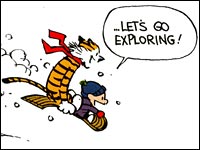
In ending this chapter of this blog, I am reminded of the final instalment of the "Calvin and Hobbes" comic strip, in which Calvin, the boy with a gifted imagination that transforms his stuffed tiger, Hobbes, into a real but friendly tiger with a quick wit, steps outside with his sidekick into a world covered by freshly-fallen snow and exclaims, with toboggan in hand: "Let's go exploring!"

A special welcome to those arriving here at The DIGITAL Archive for the first time and a warm welcome back to my casual/constant readers. This will be a short but important posting, one that will affect the future of The DIGITAL Archive.
After 5 and a half years working in the McGill University Archives, including 2 years working on digitalpermanence (the McGill University Archives' electronic records management and preservation project), I have decided to move on and explore other avenues.
While this marks the end of my time at McGill University (and marks the beginning of a hopefully short unemployment period and a major job search), the future of this blog is not in jeopardy.
It's amazing how this curiously named medium--blog--has given me a new perspective on technology and information, and on the evolution of sharing knowledge and exchanging ideas. It's amazing how bloggers that blog about libraries and archives and digitization and digital projects (and you know who you are) have broadened my horizon.
In a way, thanks in part to their enthusiasm and their daily commitment to post news and observations about the world of digital information, these dedicated bloggers helped me make the decision to move onward.
The decision to leave one's job is never easy, particular when the experience was positive. But sometimes the gut feelings and flashing lights are too strong and persistent to ignore, and the courage to make a tough decision surfaces and propels you forward. By chance, I even bumped into a few blogs about just that, here and here.
"OK, so what about The DIGITAL Archive?" you ask.
The DIGITAL Archive--in name, in URL, in design--will remain as such for now. But I will omit its affiliation to McGill University (actually, it was always ad-hoc and unofficial to begin with). Should readers wish to learn more about the McGill University Archives' digitalpermanence project, I encourage them to visit the University Archives' website.
The content of The DIGITAL Archive will change, however. One thing I've noticed about blogging is that content evolves as the writer begins to grow more confident, more focused, on his or her topic of choice. I would like to track interesting news stories that involve digitization projects, institutional and governmental digitization initiatives, digital preservation, the evolution of the Web, the dissemination of online information, RSS, podcasting, the future of archives and libraries, plus a few personal commentaries and observations, if I can squeeze those in as well.
Consider this blog as my connection to world of digitization. I'll use it to stay current as I embark on my job search into--surprise, surprise--the world of digitization.
I promised to make this posting short, but looks like I blew it.
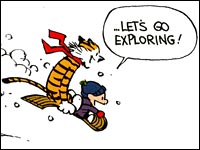
In ending this chapter of this blog, I am reminded of the final instalment of the "Calvin and Hobbes" comic strip, in which Calvin, the boy with a gifted imagination that transforms his stuffed tiger, Hobbes, into a real but friendly tiger with a quick wit, steps outside with his sidekick into a world covered by freshly-fallen snow and exclaims, with toboggan in hand: "Let's go exploring!"

Monday, February 13, 2006
Technical Glitches
In reading The DIGITAL Archive, you may notice that the paragraph formatting has gone haywire.
I was tweaking settings over the weekend (and I suspect I fooled around with things I should not have) and there we go. No more paragraphs, just blocks of text.
Hang in there as we fix this technical difficulty.
I was tweaking settings over the weekend (and I suspect I fooled around with things I should not have) and there we go. No more paragraphs, just blocks of text.
Hang in there as we fix this technical difficulty.
Wednesday, February 08, 2006
Article: The End of the Internet?
Is the Internet as we know (and love) about to come to an end?
The Nation has an eye-opening article.
And just when I was getting used to this Internet thing...
The Nation has an eye-opening article.
And just when I was getting used to this Internet thing...
Wednesday, February 01, 2006
Tuesday, January 31, 2006
The Digital Preservation of Blogs
Many posts ago, I wrote a piece on whether archivists should digitally preserve blogs. I asked whether preserving blogs should be done, and how should archivists go about doing so, if the decision is made to do so?
The Rogue Librarian discusses this issue in a thoughtful manner. Quoting from RL's post:
"How will tomorrow'’s historians understand the development and impact of blogs? What evidence will future researchers turn to when they want to examine the influence that blogs had on Howard Dean'’s 2004 presidential campaign, or how a blog post disgraced 60 Minutes by revealing that what was believed by Dan Rather to be a legitimate memo about George W. Bush'’s military service was a forgery? What primary source material will show that it was a blogger who filed a Freedom of Information Act request and posted 361 snapshots of coffins of solders killed in the US war in Iraq?"
As a history grad, I can appreciate RL's perspective on the historical significance of blogs (as a communicaton and news & information tool as well as a cultural phenomenon).
The Rogue Librarian also mentions that a group of library school students were investigating the technical, social and legal problems posed by the preservation of blogs
Maybe some of you have some thoughts on this?
Monday, January 30, 2006
Google.cn: The Aftermath
In my last post, I talked about Google's presence in China and its decision to censor certain keywords at the request of the Chinese Government.
Andrew McLaughlin, Senior Policy Counsel at Google, wrote a post on January 27, 2006, called Google in China, that argues Google's decision and responds to criticism expressed by the public.
Granted, this and other news items that I have posted lately have no direct connection to digization or McGill's digitalpermanence project.
But I believe that in pursuing digitization and digital perservation we are in fact pursuing improving and increasing access to information now and in the future...something which Google's decision somewhat strays away from.
Wednesday, January 25, 2006
flip-flop.google.com
Is freedom to search and access information on the web in jeopardy?
About a week ago (time passes so quickly nowadays, I'm not even sure), I read that Google had successfully resisted U.S. Government pressure to hand over search query data, which the search engine giant collects. The company earned plenty of praise. Privacy had prevailed.
Now I'm reading a news article in The Register that explains Google's recent decision to tailor its new Google China website to the specifications of the Chinese Government. According to news reports, including an interesting (and revealing) article from China Daily, the Communist government wants Google to self-censor certain keywords that are forbidden under local Chinese laws and policies in order for Google to do business in China's expanding economy and middle class. The China Daily article explains:
"The government bars access to 20 broad content categories, including pornography and other banned material."
While I can understand banning pornography, I wonder about those 20 broad content categories and that nebulous 'banned material.'
However, Google co-founder Sergey Brin considers his company's decision painful but right.
Mind you, Google is not the only Internet company to apply self-censorship. MSN and Yahoo have done the same in order to do business in China, which, according to the latest economic reports, ranks China as the fourth largest economy in the world, right after the United States, Japan, and Germany.
My point in all this, I guess, is: We create content and we upload content to the Web; as professionals we embark on digitization projects to make our collections, books, whatever, more accessible. But then the means to search and find our endeavours is blocked by government censors or search engine filters because the works may contain forbidden material.
The second point: I am surprised at how companies (i.e. Google), for the sake of doing business in a lucrative market such as China's, will sweep some of their guiding principles (i.e. Do not evil) under the proverbial rug.
So, is freedom to search and access information on the Web in jeopardy?
I guess it all depends on the country you live in.
Tuesday, January 24, 2006
Political Winds of Change
On January 23, 2006, Canada elected a new Prime Minister. Stephen Harper, the leader of the Conservative Party of Canada, was voted in as Canada's 22nd Prime Minister. In the House of Commons, his fellow Conservatives will form a minority government, which means Harper and his Cabinet must make alliances with the other political parties (Liberals, New Democratic Party, Bloc Quebeçois, etc) in order to make and pass new policies and laws. It will be will an interesting Parliament, to say the least.
That said, I am interested in learning more about Harper's vision and plans for such areas as universities, academic and research funding and for government agencies such as Canadian Heritage and Library and Archives Canada. His political policies will impact these areas.
Politicians are always dodgy during the campaign - mostly promising the world and the moon and the stars. But with the campaign over, the concrete plans will be unveiled.
As a political agnostic in true Canadian form, I do not believe in one particular political party. They each have their merits. However, I do believe that one political party with at least a decent vision for the country and its institutions, and a commitment to rally the public around the vision, can certainly make a positive difference.
With this vote, Canadians chose not to support the Liberal Party as they had done for the past 13 years and instead put their cautious trust in the Conservatives.
Here's hoping for Canada's continued success.
Monday, January 23, 2006
Predictions 2006: Future Prospects for Librarians and Archivists
This is the third post in my “Predictions 2006” series. The aim is to make some predictions, based on trends, about the future of libraries, archives, Web technologies, electronic records management, digital preservation, etc. I make these predictions with a mix of reflection and spontaneity.
In this installment I will explore the future career prospects for librarians and archivists. I must admit, I had not planned on writing on this topic. But after reading 2 particular news items in the past couple of weeks, and in reading a few blogs that covered the same topic, I felt it important to discuss this matter.
This prediction is not pretty, I should caution. It will force many librarians and archivists, particularly new professionals in the field (like me), to wake up to some hard realities and develop a career strategy to confront and conquer the difficult issues happening now and in the future. However, it is not all doom and gloom, for I also predict that the future is bright (a kind of sunshine bright that shares the sky with scattered storm clouds) as long as librarians and archivists are passionate about a given area in the field and embrace a multidisplinary approach to their profession and are willing to take risks and flex their creative muscles.
A little background...
The first article I read that prompted this post originated from the US News & World Report's website. The article, "Career Center: Excellent careers for 2006," listed the top 10 careers for 2006. Among the top ten was--suprise, surprise--the field of librarianship. Granted, the article did not explicitely mention archivist. However, there are enough similarities to both professions (we both select, organize, retrieve, transmit important information and often, at least in an academic setting, are coupled with libraries) that, for the sake of argument, I will say that archivists and librarians are connected.
Here's an excerpt from the US News & World Report article:
Librarian: This is an underrated career. Most librarians enjoy helping patrons dig up information. They learn in the process and keep up to date on the latest books and online resources. The need for librarians, unfortunately, may decline because search engines make it easy for patrons to find information without a librarian's help. The job growth for librarians will be in nontraditional settings: corporations, nonprofit organizations, and consulting firms.
For me, 2 things popped out at me after reading this:
Among other things, the study revealed:
Librarians complained that there was not enough variety in their work, that they did not have enough control over their careers, and they were not allowed to put their skills to full use. The lack of job satisfaction meant they were more likely than other professions to be absent from work, or to vent their frustration on their families when they got home.
Mr. Saddiq concludes, explaining that "they [librarians] are sick of being stuck between the same shelves of books all day. They also found their work repetitive and unchallenging, and overall had very little job satisfaction..."
Like the first article, something popped out at me after reading this article:
In reading these articles and other people's opinions, and in reflecting on my own personal work experiences, I believe and I predict that the future prospects for librarians and archivists will be, well, it depends. Let me explain.
I went on a conference hosted by the International Council on Archives Section on University and Research Institution Archives (ICA/SUV) last year in September 2005. It was a good friendly crowd of archivists from around the world with different backgrounds and interests ...and with one thing in common: they were underfunded, understaffed, and overworked. This was repeated over and over again to the point where I became frustrated. Ah, frustrated. Frustration over the fact that, though there was much work to be done and many exciting projects to start (e.g. digitization, digital preservation), there was little funding to pursue these projects.
Why so little funding?
The fact is, in our current world, where appearances mean everything, the libraries and archives are perceived as being part of the past, a derelict storage room of aging material and books. It is seen as neutral--what does it contribute?--and as a result not very high on priority lists or budgets.
If this is indeed the wide-spread case, then how does one change the status quo, and what does this mean in terms of future career prospects for librarians and archivists?
To make any change, one must start with the self. To be a librarian or an archivist nowadays, I believe one must have passion. There are many difficult obstacles and plenty of frustrations on the road ahead, so passion--real dedication, not lukewarm woo-hoo--will keep fueling your committment.
It is also important to become an expert or, in other words, find an area in the field in which to dedicate yourself. If you're not feeling this passion, this dedication, then I would suggest you pause and review your options and motives, because this is absoluetely critcal to your future career prospects.
A lot of problems that libraries and particularly archives face revolve around being misunderstood or, worse, institutionally "invisible." What should librarians do in the age of Google? What should archivists do beside carefully shelve boxes of records and priceless artifacts? The days of remaining "mysterious" or hidden are over. It's time to broadcast the real story.
Whatever course of action professionals take to get the message out, there must be a good dose of a multidisciplinary approach included. Multidisciplinary, interdisciplinary, call it what you like, but in universities and for acadmics this is the future. Why not say the same for librarians and archivists? Just like no man is an island, no librarian or archivist is one either. Cooperation, collaboration, and relationships are essential. Making a library or archives part of a larger body of study, research, or community involvment is paramount.
A question to consider: Should Google replace librarians? Of course not, no! Sounds like a simple question whose answer is a given. But truth is, the answer is not on the tip of everyone's tongue. Another question: Should an archivist be content with having his or her collections sit on a shelf? No! Collections are meant to be shown, and today's technology makes it possible (and relatively inexpensive) to do so.
It's all about not assuming anything, and being proactive in everything.
In short, I predict the future career prospects of librarians and archivists in 2006 will be (using this addictive weather analogy of mine) sunny with cloudy periods.
To burn away those excess clouds, I suggest that the new librarian or archivist entering the profession should be:
The key to making this job still one of the "most excellent" careers is embracing your opportunities and minimizing the drawbacks. If you need a change in libraries scenes to increase your opportunities then so be it. Change is scary but it is also a good thing. Any job could be classified as boring. Any job is what you make of it.
Well said! Embracing your opportunities and minimizing the drawbacks or taking a risk and changing directions if opportunities present themselves elsewhere. Now that is the future of the library and archives profession. Good luck!
In this installment I will explore the future career prospects for librarians and archivists. I must admit, I had not planned on writing on this topic. But after reading 2 particular news items in the past couple of weeks, and in reading a few blogs that covered the same topic, I felt it important to discuss this matter.
This prediction is not pretty, I should caution. It will force many librarians and archivists, particularly new professionals in the field (like me), to wake up to some hard realities and develop a career strategy to confront and conquer the difficult issues happening now and in the future. However, it is not all doom and gloom, for I also predict that the future is bright (a kind of sunshine bright that shares the sky with scattered storm clouds) as long as librarians and archivists are passionate about a given area in the field and embrace a multidisplinary approach to their profession and are willing to take risks and flex their creative muscles.
A little background...
The first article I read that prompted this post originated from the US News & World Report's website. The article, "Career Center: Excellent careers for 2006," listed the top 10 careers for 2006. Among the top ten was--suprise, surprise--the field of librarianship. Granted, the article did not explicitely mention archivist. However, there are enough similarities to both professions (we both select, organize, retrieve, transmit important information and often, at least in an academic setting, are coupled with libraries) that, for the sake of argument, I will say that archivists and librarians are connected.
Here's an excerpt from the US News & World Report article:
Librarian: This is an underrated career. Most librarians enjoy helping patrons dig up information. They learn in the process and keep up to date on the latest books and online resources. The need for librarians, unfortunately, may decline because search engines make it easy for patrons to find information without a librarian's help. The job growth for librarians will be in nontraditional settings: corporations, nonprofit organizations, and consulting firms.
For me, 2 things popped out at me after reading this:
- The need for librarians will decline because search engines make it easier for patrons to find information;
- Job growth will occur in nontraditional settings: corporations, non-profit organizations, consulting firms
Among other things, the study revealed:
Librarians complained that there was not enough variety in their work, that they did not have enough control over their careers, and they were not allowed to put their skills to full use. The lack of job satisfaction meant they were more likely than other professions to be absent from work, or to vent their frustration on their families when they got home.
Mr. Saddiq concludes, explaining that "they [librarians] are sick of being stuck between the same shelves of books all day. They also found their work repetitive and unchallenging, and overall had very little job satisfaction..."
Like the first article, something popped out at me after reading this article:
- Despite the lack of detailed information on those surveyed, the article boils down the situation of librarians to this: it is unglamorous, unappreciated, and therefore stressful
In reading these articles and other people's opinions, and in reflecting on my own personal work experiences, I believe and I predict that the future prospects for librarians and archivists will be, well, it depends. Let me explain.
I went on a conference hosted by the International Council on Archives Section on University and Research Institution Archives (ICA/SUV) last year in September 2005. It was a good friendly crowd of archivists from around the world with different backgrounds and interests ...and with one thing in common: they were underfunded, understaffed, and overworked. This was repeated over and over again to the point where I became frustrated. Ah, frustrated. Frustration over the fact that, though there was much work to be done and many exciting projects to start (e.g. digitization, digital preservation), there was little funding to pursue these projects.
Why so little funding?
The fact is, in our current world, where appearances mean everything, the libraries and archives are perceived as being part of the past, a derelict storage room of aging material and books. It is seen as neutral--what does it contribute?--and as a result not very high on priority lists or budgets.
If this is indeed the wide-spread case, then how does one change the status quo, and what does this mean in terms of future career prospects for librarians and archivists?
To make any change, one must start with the self. To be a librarian or an archivist nowadays, I believe one must have passion. There are many difficult obstacles and plenty of frustrations on the road ahead, so passion--real dedication, not lukewarm woo-hoo--will keep fueling your committment.
It is also important to become an expert or, in other words, find an area in the field in which to dedicate yourself. If you're not feeling this passion, this dedication, then I would suggest you pause and review your options and motives, because this is absoluetely critcal to your future career prospects.
A lot of problems that libraries and particularly archives face revolve around being misunderstood or, worse, institutionally "invisible." What should librarians do in the age of Google? What should archivists do beside carefully shelve boxes of records and priceless artifacts? The days of remaining "mysterious" or hidden are over. It's time to broadcast the real story.
Whatever course of action professionals take to get the message out, there must be a good dose of a multidisciplinary approach included. Multidisciplinary, interdisciplinary, call it what you like, but in universities and for acadmics this is the future. Why not say the same for librarians and archivists? Just like no man is an island, no librarian or archivist is one either. Cooperation, collaboration, and relationships are essential. Making a library or archives part of a larger body of study, research, or community involvment is paramount.
A question to consider: Should Google replace librarians? Of course not, no! Sounds like a simple question whose answer is a given. But truth is, the answer is not on the tip of everyone's tongue. Another question: Should an archivist be content with having his or her collections sit on a shelf? No! Collections are meant to be shown, and today's technology makes it possible (and relatively inexpensive) to do so.
It's all about not assuming anything, and being proactive in everything.
In short, I predict the future career prospects of librarians and archivists in 2006 will be (using this addictive weather analogy of mine) sunny with cloudy periods.
To burn away those excess clouds, I suggest that the new librarian or archivist entering the profession should be:
- Passionate
- Dedicated to an area, be it public libraries, digital libraries, digital archives, etc
- Confident and capable in dealing with workplace frustrations, particularly funding frustration
- Multidisciplinary, that is, forming relationships and integrating into other fields
- Creative
- Risk-Taking
The key to making this job still one of the "most excellent" careers is embracing your opportunities and minimizing the drawbacks. If you need a change in libraries scenes to increase your opportunities then so be it. Change is scary but it is also a good thing. Any job could be classified as boring. Any job is what you make of it.
Well said! Embracing your opportunities and minimizing the drawbacks or taking a risk and changing directions if opportunities present themselves elsewhere. Now that is the future of the library and archives profession. Good luck!
Wednesday, January 18, 2006
Worldwide E-Gov Initiatives Huge: Is digital management and preservation ready?
Federal Computer Weekly (FCW) is both a magazine and a web publication that covers IT and IT-related news affecting the US Government's information technology infrastructure. Overall, it's an interesting read, for the most part.
FCW.com hosts 2 blogs, one of which, called Culture and Context, had a post that discussed the growing size of e-government--in this case, the number of webpages operated by governments worldwide.
With a whopping 368 million webpages, the US Government e-gov has the most number of webpages, followed by its little brother, and my home and native land, Canada with 12 million webpages.
I hope someone's considering the electronic records management issues here (which webpages should be kept?), as well as electronic preservation issues (which webpages should be archived for posterity, and how?).
The top ten largest e-gov initiatives (in terms of number of webpages) are available on said blog and as part of a larger research [PDF] project published by the Electronic Government journal.
It's wet, it's icy, it's a mess!
 From time to time, The DIGITAL Archive is affected by things beyond its control. Today, the weather is the culprit.
Late last night, the island of Montreal--no stranger to strange weather--experienced freezing rain, straight rain, and then more freezing rain. Taken together (and add in a mix of little or no street salting or cleaning), and Wednesday morning started off on a rather slippery note.
So I am writing this post from the comfort of my warm and dry abode.
Photo: This house's roof has a patch of snow encased in a layer of ice.
UPDATE: The weather continues to be, in the words of mostly all radio announcers on both English radio stations (CJAD, CINW) in Montreal, absolutely miserable.
UPDATE 2: The streets surrounding McGill University are closed due to icy conditions and flooding. The campus is located at the base of Mont Royal. Flooding + Archives = Not Good
Sunday, January 15, 2006
News: EU countries to build digital library to rival Google
From China's People's Daily Online (yes, I read 'em all):
Jean-Noel Jeanneney, Curator of French National Library, told media that European libraries would digitalize 50,000 to 60,000 books by the end of 2006 and the construction of the program would be in full gear in 2007. France promised to digitalize at least 15,000 books and fund 15 million euros a year.
Subscribe to:
Posts (Atom)


