Saturday, August 30, 2008

It was 14 years ago today....

On August 30, 1994, the music world and my own personal musical tastes were changed with the release of an album called "Definitely Maybe" by a then-small band called Oasis from Manchester, England. A year later, the band released "(What's the Story) Morning Glory?" an album, as I recall, that was overflowing with one hit single after another.

The songs from those two albums flooded my head and floated me through university. This was the British Invasion for my generation marked by a sound that mixed Britpop with wall-to-wall guitars and anthemic-lyrics.

In North America in the early nineties, the music landscape was shaped by grunge music, an alternative style of music that surfaced in Seattle, Washington, and focused on shifting music dynamics (quiet then loud, quiet then loud) and angst-filled, apathetic lyrics.

Britpop in general and Oasis in particular, however, were different. It was celebratory, cocksure, full of swagger. It was a momentary breath of fresh air in a grunge atmosphere.

In 2004, Noel Gallagher, discussing his band's first album and its impact ten years later, explained that the the music he wrote tapped into "what was missing in a lot of people’s lives."

The band is about to release its seventh album, "Dig Out You Soul" in October 2008.

We live in a fast-food band era. Bands come and go; they are marketed to death, reach saturation, and then gladly fade away.

The mark of a good band is its longevity or more specifically the longevity of its music. We all have bands and songs like that, stirring in our heads and, hopefully, playing in our iPods.

Is the musical scene fertile once again for longevity or are we seeding short-term musical sprouts?

Monday, August 18, 2008

Environmental Factors

I spent a week visiting family and friends in Canada's largest city, Toronto. I had a good time seeing new places, doing new activities, and, more importantly, gaining a new perspective or outlook on matters, perhaps one of the best benefits of taking a vacation. Like all vacations, however, they are not long enough.

For those familiar with Canadian cities, there has been a long rivalry between Toronto and Montreal, with each city claiming to have the best in everything from businesses and sports teams to restaurants and night life.

Truth be told: Toronto is a powerhouse of a city filled with busy busy people. Montreal on the other hand is laid back with what the French call a 'joie de vivre' - an enjoyment of life and life's pleasures.

Take your pick. Which city would you prefer?

Sometimes I wonder if one's environment--neighborhood, town, city--affects (negatively or positively) one's success in life?

Something to ponder, I suppose.

Since I am barely able to type out this sentence (brain is drained, I think), I reckon it is best to say that I hope to write more once my brain recovers from vacation mode.

In the interim, I hope you're enjoying your summer!

Friday, August 08, 2008

Not So Abstract Friday Abstract

I will take a short hiatus from blogging. With summer seemingly drawing to an early close this year in these parts, I might as well take advantage of the remaining sun and warmth (and rain clouds) that grace our sky 2-3 months a year.

Thursday, August 07, 2008

Singapore Bound

Yes, it can now be revealed, I, no no....wait....

I received an email from a good friend and fellow library school graduate a few weeks ago in which he told me he had accepted a Cataloguing/Metadata Librarian position. That's great, I thought. I must admit, however, I was a little puzzled by the news since he had only two years earlier accepted a similar position at a very prestigious university in California.

He told me the position was in Singapore. I thought I read the email incorrectly. Nope, I read correctly, it's Singapore.

Originally from Hong Kong, this move from California to Singapore would be for him and his wife more of a coming home, or at least closer to the region and the people they are most familiar with.

He will start in late August as Cataloguing/Metadata Librarian at Singapore Management University Library. After visiting the university website and library site, think about how the world is changing, how through technology, the world is truly becoming a more connected place.

Postscript to Why I Blog

I want to thank both new and long time readers for stopping by and reading and commenting on the three-part series on why I blog. When the idea came to write on this topic, I was seeing in my mind the post growing longer and longer, because I saw several stories surfacing that needed telling. This is gonna be too long, I figured.

Unsure on how to proceed, I arrived, unexpectedly, on a website article called "How to write for new media" on a blog called thePuckWrites. In the article, the author advises writers of blogs and new media to follow a few simple guidelines, including breaking down long posts into a series. Voila!

In short, I wrote this 'long blog post' to shed an objective light, and perhaps derive some insights, on a peculiar work experience. Presently, the situation remains in flux, full of unknowns, and marked with further inward reflection. The act of blogging, however, is action. Positive action.

Wednesday, August 06, 2008

Why I Blog: Part 3


In Part 2 of the series on why I blog, I discussed the evolution of The DIGITAL Archive blog from a humble blog chronicling a research project to a public platform expressing personal and professional thoughts, opinions and observations. Moreover, the struggle to find a new direction after the research project ended became its primary content.


In this third and final part, I will clarify the reasons why I blog in light of this unconventional history.


Towards self-discovery

In a weird way, The DIGITAL Archive is living up to its name. It is an archive, a digital one, containing thoughts, opinions and observations, not all well-organized as it should be but good enough, I guess.


I write to communicate. I am not the best writer in the blogosphere, but I have the passion, the patience, and the risk-taking instincts to sit my butt on a chair and type and to do so honestly.


The words I choose to write and publish on The DIGITAL Archive are in many ways stories about self-discovery. They are not weepy talk show stories to be psychoanalyzed. Rather, they are stories about someone proudly working in a field, actively writing about the field, about the impact of larger forces on the field, and in the course of doing so, seeing himself in a new light and writing about the bigger picture, the forces causing change, and, more importantly, the possibility of discovering his own passions.


That said, faithful readers (yes, all three of you), if you are looking for a hardcore archives blog, then this blog is not for you. While I am pleasantly surprised and thankful that The DIGITAL Archive appears on the All About Archives, Blogs by archivists section of a much larger archives-focused wiki, this blog does not attempt to represent the field or cover issues of urgent concern to archivists.

What you see me doing, isn't what I do / Who I am, isn't really who I am

Jill-Hurst Wahl, who blogs over at Digitization 101, wrote a blog post called “What you see me doing, isn’t what I do.” A very thought-provoking piece, it had a significant role in prompting this series on why I blog. (Blog ideas, like story ideas, rarely occur in a vacuum.) In her blog post, she focuses on a book whose chapter examines the contrast between what people do to earn a living (make money) and what they do to fulfill creative urges. In a brilliant paragraph, she describes herself using this work-life/creative-life paradigm:


I am a consultant, a speaker, an author, an adjunct faculty member, and a trainer. I used to describe myself as a corporate librarian. Many years ago, I describe myself with words that talked about my work in information technology. And many, many years ago, I worked in radio as well as with children in a local park. What you are likely not to see is that I'm also a wonderful gardener, a person who cares about the environment as well as friends and colleagues, and a good cook (all parts of the creative me).

What you see me doing, isn’t what I do. Think about that for a second. The work we do, to earn money, to pay the bills, is often not the complete picture of what we do or who we are. The other parts are often revealed in our creative endeavours. Now let's tweak that zen-like sentence a bit. Who I am, isn't really who I am. A business card or job title will state who you are in the context of work: Archivist, Librarian, Records Manager. But the actual work that one does may be very, very different from the work typically associated with those job titles.

The work I did over the years in the archives field, which I accomplished successfully and which was well-received by employers, was not the work of a traditional archivist. The work I performed established foundations and structures (workflows and procedures, to be technical) where none existed before. I was and still am the first wave, the Marines, if you will, the first pair of boots to tackle a large-scale project, be it a website re-design, research project, digitization initiative or digital preservation.

That said, I am seeing myself more and more as an archives advocate and general consultant and less and less as an archivist. I feel I can have a greater impact and more fulfilling experience by working in another capacity. And this is my new direction.

A third reason why I blog

In Part 1, I said I blogged for two reasons; having come this far telling this story, I believe I blog for three reasons. Besides blogging to voice opinions and to share them with others and to partake in a community, I blog to beat back cynicism incurred by chronic unemployment.

A contractual employee, like me, experiences the unknown every time his or her contract comes to an end. It is a frustrating, repetitive cycle: being hired, working hard, completing assigned task, delivering excellent results, and then out the door in one or two years. Forget about professional development. Hello professional stagnation.

Therefore, I blog to beat back the cynicism and the frustration that naturally arise from these experiences. I blog, that is, I create something in the face of negativity in order to believe (or convince myself) that there is still hope.

Consider this three-part blog series an abridged version of eight unconventional years in the archives field. In the end, I am faced with a career paradox: I am stuck, but I am free. I am bound when I believe I am bound, but I become unbound when I think otherwise.

If past mistakes, poor decisions, or whatever else from your past plagues you, remember this: We are not defined by our past. We define ourselves--who we really are--only in the present moment.

I blog in order to stay in that moment.

Tuesday, August 05, 2008

Why I Blog: Part 2

From then until now

In Part 1 of this series on why I blog, I provided an overview about why I blog. 1) To share information and 2) to participate in the community of bloggers.

I also discussed how this blog, The DIGITAL Archive, was born out of the need to communicate and share information on an electronic records management and digital preservation project that I had been researching at the university where I worked and how starting the blog allowed me to connect with others with similar interests.
For the second part, I will examine the new direction the blog took after the e-records management/digital preservation project ended.

What next? My concerns become content

Once the project ended, I found myself—and this blog—in a momentary vacuum. What do I blog about now, I thought. For a while, I continued to blog about the research project, adding some personal perspective to the findings. That was fine, for the time being, but I knew deep down I had to find a new direction.

The struggle to find a new blog direction, that is, what would I write about, became the motivation to continue writing The DIGITAL Archive and the subject matter of several blog posts. This struggle, and subsequent blog posts about it, began to take a new shape, innocently enough, causing me to wonder about pursuing a new direction altogether, in life and career.

In the months between the end of the research project and the day I resigned from my position at McGill, I took tentative steps to expand the scope of the blog. While I discussed email management and digital preservation with some zeal, I also peppered the blog with concerns about preserving blogs, technology predictions, and the future of the Web, subjects I found closer to my heart and mind.

Moreover, in an unplanned move, I also discussed concerns and doubts about the career I found myself in because I wanted to give voice to these concerns and wondered if anyone else felt the same.

When I resigned from the university, I wanted to continue blogging because I had found an ingenious communication medium and had established a very small community of readers (judging from the occasional comment, I figured I had some readers).

I realized that it took time and persistence to find a ‘blogging voice’ and a central theme around which blog posts revolved. I figured I was still a teenager whose blogging voice was changing, maturing. The blog’s voice, as well as its author’s voice, was clearly changing. The DIGITAL Archive, once heavily focused on archives, became a kaleidoscope of ideas that only alluded to archives.
I believe a blog is organic, like a tree that starts life as a tiny twig; it grows into a complex repository of opinions and ideas, with shoots springing forth into other blogs, bearing fruit now and then. Sometimes, however, especially when the blogger’s situation is precarious, the blog grows in ways the blogger never anticipated.

Monday, August 04, 2008

Why I Blog: Part 1

Rationale, Reasons

The act of blogging is, in a way, similar to a person standing on a street corner sounding off on an issue of personal importance, hoping that someone passing by will stop and listen. The blogger writes and publishes blog posts, hoping his or her words will find an audience. Like raising a child and watching them grow and leave, the blogger releases his words never sure of their destiny.

Taken to one extreme, the act of blogging becomes a narcissistic activity, where the messy details of a blogger’s life become blog post fodder, an indiscriminate exposé of daily life. In an ideal, more balanced form, however, the act of blogging is as a two-way communication street and a social networking hub, whereby the blogger expresses and shares opinions, observations and ideas to those reading, and allows for—in fact, encourages—the community of readers to respond, react and generate further discussion, thus building new ideas, new knowledge, and a stronger community.

I hope my blogging activities, that is, The DIGITAL Archive, falls somewhere between narcissism and idealism.

So why do I blog (against all odds, some might add). I blog for two reasons:
  • To give voice to personal thoughts, opinions and observations on the news and current events that I care about and;

  • To partake in the community of bloggers, whether the common thread is based on locality, interests, or profession

Like layers in an onion, however, there is more to the story.

About a project called digitalpermanence

I opened a Blogger.com account in early 2004, but I only started blogging in March 2005. In 2004, the McGill University Archives (where I worked at the time) embarked on a large, ambitious project called digitalpermanence, the university’s attempt at a comprehensive electronic records management and digital preservation strategy.

In January 2004, a small team of McGill archivists was assembled, including me, and tasked to conduct a campus-wide survey of the university’s electronic records and to devise a preliminary e-records management plan and digital preservation strategy. The first phase of the project ran between January 2004 and November 2004, with the second phase--reviews and discussions-- starting in early 2005 (about the time I started blogging). For those interested, the full story of the project is available online on the McGill University Archives’ digitalpermanence sub-site.

In March 2005, with a ton of research information sitting on my desk, I wanted to chronicle the findings of the project.

While our team produced official reports, I, personally, wanted to share information about the project, thus fulfilling that academic urge to share and build upon existing knowledge. I started blogging because the medium intrigued me and because I felt I was conducting important research and no one (outside of McGill) knew about it. I felt I had no one (aside from the already swamped archivists) with whom I could relate this information to, so I started a blog and called it The DIGITAL Archive, explaining in a note that it was an ad hoc, unofficial university blog, not associated with the university.

My first blog post was called “All Systems Go!” Like that lone voice on a street corner, I hoped the words I wrote on electronic records management and digital preservation would reach someone. Discreetly, I blogged about the project, what had taken place and what findings, if any, were being discovered. It was a great learning experience on two fronts: the research on e-records management and digital preservation proved fruitful, on one front, and the hands-on blogging experience taught me much about this new publishing medium.

By blogging, I had a voice, or at least the project had a voice. In a few shorts weeks, at least two or three other blogs made direct references to the blog. Now not only had I a voice, but I was becoming part of a community of bloggers who also shared in some of the project’s discussions. Slowly, the blog’s audience grew and I, the blog’s author, began to connect with other bloggers in the blogosphere.

As the blog was hitting its stride, however, the digitalpermanence project--second phase--came to a halt. This was about fall 2005. The reports I had written were filed away—archived, I would like to think—and the small team assigned to the project moved on to other projects and some to other endeavours.

But The DIGITAL Archive blog, born out of a now dead project, still stared and blinked at me with life and potential. But I was not sure what I was going to do with the blog; in fact, I was not sure what direction my career would take after this large-scale research project ended.

You see, I was a contractual employee working in the archives on a project-by-project basis, the majority of which focused on supporting Web and digitization initiatives. With web and digitization projects under my belt, I welcomed such a large research project. But now the research project had ended as well, and I was confronted with the reality that this was perhaps the end of the line.

Curiously, this struggle to find a new direction, in career and in life, played a pivotal role in the future of The DIGITAL Archive blog.

[Part 2 to be published tomorrow and Part 3 the day after]

Friday, August 01, 2008

The Friday Abstract: Who am I?

Here is a brain teaser that should keep you thinking all through the weekend. Well, I hope so, anyway. It certainly has kept me thinking for a long, long time.

Who am I?

I have a Master of Library and Information Science degree, but I've never worked in a library (though the only time I worked for a library, I worked from home).

I worked in an archives alongside archivists and records managers; I've implemented software and hardware solutions in archives; re-designed websites and conducted research on behalf of archives. But I can count on my hands and toes the number of times I actually accessioned a box of records or personal manuscripts.

I work with technology--the Web and its many uses come easy to me--but I am hardly a technologist or guru. I do excellent work. Former employers are more than pleased.

I work on contract, and once a contract ends, I am back to square one all over again.

Who am I?

Wednesday, July 30, 2008

How to Maximize Your Micro-Blogging

The use and impact of micro-blogging continue to amaze me. There are currently four major micro-blogging services available. There is Twitter, Jaiku and newcomers Plurk and identi.ca.

Each service allows users to send out, in 140 characters or less, a status update or a tweet (if you are using Twitter) or a plurk (if you are using Plurk) to make an announcement, ask a question, promote an event or new blog post, or update friends, and so on.

The Twitter phenomenon in particular and micro-blogging in general are weaving their way more neatly and ingeniously into the pattern that is the Social Web.

In the year or so since I started using Twitter, I am discovering ways to maximize your micro-blogging.

1. Participate

The first bit of advice is as simple as pie. If micro-blogging intrigues you, or you want to learn more about this form of communication, you should participate. Get involved. If you have heard too many stories about Twitter's stability issues (i.e. Fail Whale) and want other options? Not a problem. While Twitter remains a personal favourite (and hugely popular in spite of its on-going problems), I would encourage the new user to try out other micro-blogging services such as Plurk and identi.ca.

2. Choose Your Friends Wisely

The power of micro-blogging, like all aspects of the Social Web, is community. The more participation, the more community grows and the more the service becomes truly rewarding. It is about connecting with colleagues in the same profession or even different professions. It is about connecting with someone whose status updates are thoughtful, insightful, or perhaps funny. It is about connecting with those who share your views or who hold alternative or even opposing views. Essentially, the key is to follow or befriend other users.

But I suggest you choose your friends wisely. How does that differentiate things? In order to choose wisely, I suggest you seek out friends. Be proactive.

We could randomly add friends and follow them. Nothing wrong with that per se. However, after having used Twitter for almost a year, I am noticing the signal vs. noise ratio increase, mostly in favor of more noise (unrelated, useless information) over signal (relevant, useful information). I will discuss how to handle signal vs. noise in point 4.

To build a better list of friends to follow I use Twitter Search (formerly called Summize until Twitter purchased the company) to find potential new users. Twitter Search searches tweets as they are sent. This is truly live search.

For example, I am looking for other archivists using Twitter. Enter 'archivist' (or any other archives-related search term) and click search. If one or more user stands out, I will follow them. Chances are good that they in turn will follow me. A connection is made.

I also suggest looking at the date when the person last updated. If the person you intend on following last updated 6 or 10 months ago, I would not recommend following them. It is wiser to follow those who have a current update status.

3. Speak Up (or don't censor yourself so much)

People send tweets about any and everything. I will leave it up to your good judgement to decide what and what not to tweet about. But whatever you say or ask, don't censor yourself so much. Sometimes the most spontaneous tweet receives a tremendous response, while the most carefully crafted tweet receives nothing. So be spontaneous with your status updates.

One caveat, though: Make sure your tweets are valuable to your followers. Think for a second, but not much longer than that before posting.

4. Maintenance

The issue of signal vs. noise, that is, coping with more noise (unrelated, useless information) and attemtping to find the signal (relevant, useful information) not only occurs on the Web, but in the micro-blogging space.

To combat this I follow a simple maintenance plan on Twitter. First, I remove people if their tweets are deviating from what had prompted me to follow them in the first place. I do this maybe once every two weeks. It is nothing personal. My aim is to keep the Twitter timeline as useful as possible. Second, I add more people based on the process I outlined in point 2. Finally, I make sure I am tweeting something of value to others. Am I sending tweets that could prompt someone else to follow me? Am I engaging other Twitter users by replying to their tweets? Am I partaking in conversations?

5. What about You?

You may have different experiences or different ways to maximize micro-blogging. Do share them.

[P.S. I'm on Twitter. Follow me and join the conversation!]

Tuesday, July 29, 2008

Twitter: Breaking (the) News

Circle this date on your calendars: July 29, 2008. On this date, Southern California (the Greater Los Angeles area) experienced a strong 5.4 earthquake, as reported by the US Geological Survey (USGS). But another news source, more notoriously known for its stability issues and pop culture icon Fail Whale, proved equally valuable: Twitter.

While USGS seismologists provided the world with technical data, for Web users, the first mention of an earthquake was made known by Southern California Twitter users living in and around the Los Angeles area who sent tweets detailing the rattling and rumbling, fears and concerns and reassurances that all were shaken, scared but safe, and countless other tweets from people around the world sending their thoughts and prayers.

A Twitter user named Zadi, who I follow, was the first person on my list to mention the earthquake.

The earthquake story was delivered by the people on the ground even before local news station reporters and editors had time to organize and file a report. Social networking news website Mashable went as far as to claim that, in spite of a flood of raw unedited tweets, it still scooped CNN and local news networks.

Is this the end of the old news? Has the old news been usurped by the new news? Of course not. But this story and this event do reveal the power of Twitter (and other micro-blogging websites) to break news and highlight the human element more clearly, intimately and directly than before.

Quick Update

As I ponder the possible reasons why Scientology ads are appearing on The DIGITAL Archive (Google Adsense=FAIL?), I want to tell everyone that I am working on a few new blog posts that should be published later this week.

In the interim, follow me on Twitter and FriendFeed; the first is the popular (but long-suffering) micro-blogging service, which I use for status updates, the other lifestreaming aggregator, which I use to post items I find online and share among the growing community of FriendFeed users. There are also lively discussions on FriendFeed.

As more people participate in FriendFeed, the more diverse and interesting the topics and comments get. So, by all means, join in!

Friday, July 25, 2008

The Friday Abstract: Storytelling Goes Digital

Horror writer Stephen King, the author behind such hardcover and paperback bestsellers as Carrie, IT, The Shining and others, is not afraid to test his iconic storytelling skills on new media. Read more below. If you dare.

Wednesday, July 23, 2008

Portfolio

This is where I test the power (and limits) of blog publishing. By publishing a portfolio in such a manner, I am certain I am not doing justice to what I have done professionally over the years.

But this is essentially what Web 2.0 is all about: exploration, experimentation, discovery.

Information Management / Information Technology

At the International Monetary Fund (IMF), in Washington, DC, I coordinated the evaluation and selection of a new archives management system together with the staff of the IMF Archives.
  • Responsibilities: Needs analysis, system requirements, documentation, presentation, vendor meetings, software demos; evaluation and selection process; procurement; staff training; initial implementation plans;
  • Organization: I worked with the Head Archivist, IT Advisor, Reference Archivists, and a team of 15 processing archivist;
  • Actions: Performed needs analysis, edited systems requirements documentation; scheduled vendor meetings, software demos; scheduled staff training, and coordinated with technologists on the implementation of system
  • Results: IMF Archives purchased a new archives management system to optimize staff processing activities and to provide better researcher access to collections

Also at the IMF, I was responsible for the design and implementation of a new digitization workflow for a $1 million digitization project to digitize and make available on the Web historical IMF member country files. My responsibilities involved revising scanning standards, quality control methods, and the material selection, preparation and transportation of documents to an off-site facility.

Meanwhile, at McGill University, I conducted research on behalf of the University Archives on electronic records management and digital preservation (the digitalpermanence project), producing a final report and presenting findings at an international archives conference (ICA-SUV 2005)


Web Design and Content Development

St. John Fisher Parish, Pointe-Claire, Quebec, Canada

Montreal General Hospital Medical Library

Montreal General Hospital Nurses’ Library

McGill University Archives, “The Journal of William E. Logan, 1845-1846

McGill University History Portal

McGill University Archives “The History and Tradition Installation, 1823-2003

McGill University Archives department website

GARM local archivist organization

Blogs

The DIGITAL Archive blog: Between 2004-2006, chronicled project progress; 2007 to present, a personal blog that reports on digital technology, with a focus on the Web, new media, digitization, digital preservation, and news (and views) related to information professionals in libraries and archives. http://digitalpermanence.blogspot.com/

Arch.i.vi.us blog: From February 2006 to present, aggregates news by and about archivists with a focus on digitization and digital preservation http://archivius.blogspot.com/

Archives*Open blog: A blog about archives, access, community and the Web focusing on how archivists and other professionals in the field are using technology in innovative ways to provide the public with better access to archival materials.

Publications

“The Web needs Information Professionals: Are Information Professionals Ready?” AALL Spectrum 6 : 32, 36. http://www.aallnet.org/products/pub_sp0110/pub_sp0110_Persp.pdf

Presentations

"Managing and Preserving Electronic Records at McGill University: The digitalpermanence initiative.” ICA/SUV. East Lansing, Michigan, September 6-9, 2005. Available online at http://archives.msu.edu/icasuv/presentations.htm

Tuesday, July 22, 2008

Apple to Open Flagship Store in Montreal

According to numerous reports circulating the web (here, here, and here [en français]), the flagship Canadian Apple Store will open in Montreal this coming Friday, July 25 at 5:00PM.

It is located at 1321 Ste-Catherine Ouest, near by to upscale Ogilvy's.

There are some blocks on Ste-Catherine street, the primary shopping street in downtown Montreal, that are in need of serious transformation and revitalization (I hesitate to use the word gentrification), and I hope the Apple Store will do just that to the neighborhood.

Monday, July 21, 2008

Dawn of Location-Based Information

In the real estate business, there are three words that determine the value of a property: location, location, and location. In social networking circles, where user mobility has become a standard with cell phones and the new iPhone 3G coming equipped with GPS, the same words apply, with a little modification. In order words:
  • location-based micro-blogging: Blogging on the scene

  • location-based social networking: Presence awareness by friends

  • location-based information: Contextual information based on immediate surroundings

For the longest time, I have been a Map Geek. I love maps. Road maps, old maps, new maps, Google Maps, Live Maps, and even treasure maps (don't see too many of those nowadays, though). I guess I love maps because they provide their users with so much valuable information in a very clear and precise manner. A basic highway map, for example, which one buys in a pharmacy or orders online through a department of transportation office, are extremely valuable to the weekend traveller hitting the highways.

Navigation solution providers, such as Garmin and TomTom, whose street navigation products use global positioning satellites and digital maps to provide drivers with accurate driving directions and even in some models current traffic conditions, are very popular. Case in point: I recently took a taxi from the airport back to my home. Rather than providing the taxi driver with details on where to exit the highway or where to turn right or left, he simply punched in the destination address (or the closest match) and listened to a smooth female computer voice advise him on driving directions.

As usual, upon seeing this, my brain started thinking.

While these navigational devices target automobiles, trucks, motorcycles, and boats, I want to focus on personal navigational systems in a social web context.

With the launch of the Apple iPhone 3G and its Assisted GPS technology, which connects the iPhone 3G to the closest orbiting global positioning satellite, I believe Apple will make GPS, mobile maps, and geographic information systems mainstream and consumer-friendly.

The Apple iPhone 3G (and other advanced phones to come) will be the device on which the following applications will take life.

In the location-based micro-blogging space (a term I made up that has yet to solidify until the A-list bloggers coin a better one), there is Brightkite, "a Denver startup, [that] gives users tools to post about what's going on at a location, meet up with friends, and even, if you want, meet new people in the same place," according to a news article on ars technica. So far, Brightkite is invite-only, so I can add no hands-on knowledge other than to say I like the concept of on the spot location blogging and connecting with friends in the immediate area, but I still would like absolute control over the dissemination of my location to others. For more information, read Brightkite's blog.

In the location-based social networking space, there is a piece of software called Loopt for mobile phones. I never heard of this before until Michael Stephens, the author behind the Tame the Web blog, twittered and eventually posted a screenshot of Loopt in action. Using his iPhone's location (longitude/latitude), the iPhone calulated how far away his friends were from him. Pretty neat. For more information, read Loopt's blog.

In the location-based information space, there is the little-known but impressive-sounding Fire Eagle by Yahoo. According to Yahoo, "Fire Eagle is the secure and stylish way to share your location with sites and services online while giving you unprecedented control over your data and privacy. We're here to make the whole web respond to your location and help you to discover more about the world around you." If Yahoo can deliver on this promise, this location-based web service would be a very interesting development. Like Brightkite, Fire Eagle is invite-only. There is more information available on the web, however. A blog called Pointbeing.net has an interesting post on Fire Eagle.

In the not so distant future, when all the above have matured, I envision the following scenario. I am walking downtown, in a big city, and I want to know information about my surroundings based on my immediate location. Using my cell phone (could be an iPhone or another advanced phone), I open a location-based application (software or web-based) that shows me a dynamic map. On this map, I see my avatar blinking at the exact street location where I find myself. I activate the map's shopping layer and, based upon my preferences, the map blooms with store locations dotting my surrounding area. The information would be tailored to my needs. I then activate the map's food layer and, based once again on my preferences, the closest restaurants appear on the map. I then I activate the map's friends layer, and lo and behold, I see that there are two people I know at a coffee shop two blocks away. Maybe we could meetup and have supper at a Thai restaurant. It's only a phone call away. And this would only be the tip of the iceberg.

It is clear we live in an increasingly mobile world. Laptops are outselling desktops; cell phones are becoming more advanced; communication among people on the move is proliferating. The next frontier is to deliver actionable information to people based on none other than those three magic words: location, location, location.

Wednesday, July 16, 2008

Fail Whale, Epic Fail, and Other Stories of Missing the Mark

Web_Guy: You know about Twitter, right?

Girly_Love: The micro-blogging site? Yeah, sure. Use it a lot.

Web_Guy: Yeah, well, the site's been down so frequently--and I mean, so frequently that the folks over at Twitter post a picture of a whale being lifted by the little Twitter birds to notify users that there are problems. So that's been happening so often, that we now say Fail Whale to represent anything technical that fails.

Girly_Love: Fail Whale. Poor thing. Poor Twitter.

Web_Guy: Yeah, I know, it's rough being Web 2.0. Users are in control. What they want is what they get, 24 hours a day, 7 days week, even if the site's infrastructure cannot handle the load. It's gotta be running or else. :P

Girly_Love: You'd think they would have anticipated these things. :D

Web_Guy: Yeah, you'd think. But, man, nobody thought Twitter would fly. Seriously.

Girly_Love: Oh my God. I see what's wrong. They forgot to add beta to Twitter. Look, see? No beta. ;-)

Web_Guy: You're right. [LOL]

Girly_Love: Hey, check it out. I got an iPhone 3G. Isn't he so cute? I call him iPhoney Maloney.

Web_Guy: Sweet. Too expensive for me, though. What did you say you called it...?

Girly_Love: iPhoney Maloney. I used to call him iBrick because that's what it was after I bought it and could not download the updates to the firmware. It basically became a brick. An iBrick.

Web_Guy: Rough. What happened?

Girly_Love: You know, the iTunes servers crashed and burned. They couldn't handle the demand of thousands and thousands of users.

Web_Guy: Epic Fail.

Girly_Love: Totally Epic Fail. So horrible. Sigh. But I so love my iPhone. He's so touchy. [grin]

Web_Guy: Oh puh-lease. Listen, I gotta roll. Gonna try and download Firefox 3. Rave reviews, but on download day, the...

Girly_Love: ...the servers crashed and burned. Yep, I heard. Good luck.

Web_Guy: Thanks. No more Fail Whales or Epic Fails--

Blogger Error 7x4365 - Unable to Post Blog. Try Again Later.

Friday, July 11, 2008

10 Secrets of Highly Unproductive People; Or Warning Signs!

I started following tech geek blogger (and former Microsoft employee) Robert Scoble and his vast line-up of online content a few weeks ago, and every so often he writes or broadcasts material that resonates with me.

On July 11, 2008, Scoble's Workfast.tv web program hosted Matt Rissell, a web entrepreneur and founder of TSheets.com. Rissell talked about his on-going research on the principles that highly productive business people follow and described them during the show. Rissell also posted his list of principles on his blog.

After reading the list, which I recommend everyone should do, I could identify with certain items on the list - and in some twisted way, I saw how the opposite of these productivity tips were active in my life.

So without further ado and with tongue in cheek and satire stick in hand...

10 Secrets of Highly Unproductive People

1. Boredom

You are bored with your work. You feel indifferent on most days. You could not care less if the work you did or the company you work for suddenly curled up and died.

2. Surround yourself with cynical people

There is no better way to become more unproductive than by surrounding yourself with cynics, naysayers, and complainers. Observe how your innovative ideas are laughed at and then skillfully tossed aside to be replaced by the notorious 'same old same old' or the dreaded 'business-as-usual'.

3. Create an environment where shallowness prevails

There are many types of work environments. Some are energized, innovative and focused, while others are discouraged, depressed and demoralized. Be sure to pursue the latter environment to become unproductive and as mentally deep as a kiddie pool.

4. Complicate!

This is a tricky one to achieve since most folks want to simplify their careers. But to be truly unproductive, complicate your career. Make sure your employer and the entire company do not understand what you do, so that way you end up doing a whole bunch of stuff (and not get paid extra for it). You'll certainly do a lot of stuff, but you'll never become proficient at anything. Just another graduate chasing the four winds. Perfect.

5. Know your motivation and then throw them out the door

Yes, there are moments when you want to be the best, to deliver the best, to make sure the user is satisfied, that you feel satisfied. These are the correct motivations to steer you in the proper direction. But hold on, motivation, values, work ethic, there's that productivity nonsense again. You're at work to collect a pay check, thank you, and walk out the door at 5:00 pm sharp and look forward to the weekend. Period.

6. That "Special Something"

If you have a desire to provide excellent service to the community, to communicate and help others, to make a difference; in other words, if you possess that special something that you can bring to the table, well, in those immortal words, you know, fugetaboutit!! That's right. Forget it. Your career does not need your special something, so leave it at the door.

7. Don't make decisions

You are on a committee, either the Chair or member, and the committee has convened five or maybe six or more times on the same blasted topic and no decision has been made yet. While some folks will get restless, and others will be bold enough to make a decision, why not sit back, sip a coffee, and wait. And wait. And wait some more. Maybe in 2-3 years things will change and a decision will simply fall in your lap. Now that is un-productivity at its finest!

8. Unbalance

Besides simplicity, some of us strive for balance, making sure our days are rich and complete with a variety of personal and social activities. How boring! Become unbalanced for once and watch your days grow longer and nights get shorter. Soon you'll be so exhausted, becoming unproductive will be inevitable.

9. Talk talk talk and no action

To see this tip in action is truly a thing of beauty. To become proficient, observe the masters. They are often seen talking, and talking, and talking. They talk endlessly about superfluous nonsense that is wrapped nicely in a symphony of buzz words. But in the end, no one rolls up their sleeves and no one delivers the goods.

10. Don't pay attention to successful people and their silly principles

Successful people, smart people, rich people - each are probably doing something that we unproductives are not doing. But why bother listen to them? Their philosophies are so convoluted, anyway, they'd never work. Stay true and stick to what is familiar and comfortable.

Hope you enjoyed this week's Friday Abstract.

National Film Board of Canada Digitzing Its Collection

The National Film Board of Canada (NFB), Canada's public film producer and distributor, recently launched beta.NFB.ca, a website created to showcase the Film Board's wealth of films, documentaries, animated shorts, trailers, news clips, and other productions found in its 70 year old vaults.


According to the beta.NFB.ca website, whose "mission is to make these films accessible to all Canadians," there are so far 300 full-length films and clips digitized and ready to view on the website. Furthermore, beta.NFB.ca intends on adding more films every week. The website explains that this "project was facilitated by Canadian Culture Online, which has been helping us [NFB] to digitize our film collection since 2001."

Although the website is currently in proverbial Web 2.0 beta, the website nonetheless has some very promising and impressive Web 2.0 features. Besides offering high-quality streaming video, in addition to a robust hardware and software set-up (details here), the website has these notable user-centric features:

  • Browse documentaries and animated films or search them by keyword search;

  • Film selection is accompanied by a related films column (similar to YouTube) and a descriptive note by a Film Board curator, if available;

  • Favorite films can be given a thumbs up (recommended) and shared with the social Web via such popular tools as delicious, Digg, StumbleUpon, or FaceBook, or be embedded in one's website or blog, or shared by email;

  • Viewing history panel is available resembling a roll of film (some work could be done on this);

  • Three RSS feeds;

  • News blog updating site additons and changes.

The beta.NFB.ca website looks and feels very good. The black background color invokes a movie theater, highlighting the films. The website's main navigation is clean and simple with four primary categories. As the user drills down, more navigation choices emerge but thankfully remain simple on all levels. A reasonably rugged search engine is available, though I found browsing for films more successful and rewarding. Speaking of browsing, the labels attributed to the four categories are intuitive, though I would recommend replacing "Explore All Films" with "Browse All Films."

Overall, this is a very slick web production, one that Canadians should be proud of - and the rest of the world can thoroughly enjoy.


You think you know Canada, eh? Well spend a few minutes (or hours) here and you'll learn something new. Guaranteed.

Wednesday, July 09, 2008

Have You Visited arch.i.vi.us Recently?

About two years ago, I started arch.i.vi.us, a Web 2.0 experiment to aggregate news, blogs, and more recently Twitter tweets that discuss digitization and digital preservation from an archivist perspective.

In recent months, I have tweaked the settings on my news and blog feeds and added Twitter tweets using a service called Summize. The results have been astonishing!

  • News about digitization and digital preservation from around the world

  • Blog postings from fresh voices in the blogosphere

  • Twitter tweets from archivists twittering away


Whenever I visit the page, there is something new that catches my interest.

I dislike plugging my other blog in this way, but I believe, now more than ever, the arch.i.vi.us blog is worth a look.

Unemployed? Archivists Take Note

Kate Theimer blogging over at ArchivesNext revealed the results of her survey question "Will you be attending SAA this summer?" While the complete results can be viewed on her blog, the majority of respondents (48%) said Yes, they will be attending SAA and that their employer will be paying all or part of the expense.

On the heels of this survey question, Kate is launching another: "Does your job title have the word “archivist” in it?” Be sure to take a few minutes to respond.

Speaking of job titles and jobs, I conducted a survey back in May asking people in the fields of libraries and archives what was their employment status. The results revealed that 66% of respondents had a permanent position with a benefits package.

Now, taking Kate's survey on SAA attendance, which I will categorize in my mind as professional development, and my own survey on employment status, something clear emerges. At least it does for me.

Unemployed and underemployed archivists or other records related professionals should demand more from their future or current employer. First, if having a permanent position is important, then unemployed archivists should seek out permanent positions. I know, there are bills to pay now, but short-term contracts without benefits simply short-change us professionals in the end. As I often remind myself, "Short-term gain, long-term loss."

Second, if professional development and attending conferences are important, then archivists should request and make it clear to employers that professional work is a two-way street. A professional cannot give and give and receive nothing in return. There must be opportunities to learn.

These requests are not pie-in-the-sky unattainable. Hardly. Look at the survey results again (here and here); as small a sample as they were, relatively speaking, they still revealed evidence that permanence and professional development are elements that unemployed and underemployed archivists can no longer set aside.

Tuesday, July 08, 2008

Archiving in Practice with JPEG2000

Presentation slides from the JPEG2000 for Archives and Libraries Interest Group.

ALAac2008 j2kIG - Presentations

Monday, July 07, 2008

Should We Abandon Twitter for Greener Pastures?

In the past couple of days, while I nursed a virulent strain of something or another (no more tomato and mayo sandwiches for me, thank you), I was busy following the happenings and going-ons at the 2008 American Library Association (ALA) Annual Conference in Anaheim, California, courtesy of my Twitter peeps Michael Stephens, David Lee King, and Robin Hastings, as well as others who attended and sent 'tweets' from the conference. All did a fine job, by the way, and I recommend readers of mine should subscribe to them.

One caveat: I was able to follow the minute by minute reactions and observations as long as Twitter remained stable.

Sadly, Twitter was acting a little flaky, as in sometimes it worked, sometimes it didn't. I would not go as far and say Twitter suffered a massive outage, like other times, but the service was and remains unstable.

I'm calling Twitter's recent woes growing pains. The Twitter infrastructure is new and clearly cannot handle a 24/7 onslaught of messages from thousands and thousands of users across the globe every minute of the day.

In the aftermath of these recent reliability issues, there is a small but growing movement among the micro-blogging community to switch to new, more reliable services that offer the same and perhaps even more features and functionality. [Read the TechCrunch article.]

One such exodus is to FriendFeed, a social media aggregator that allows users to post messages and comments, befriend other users and grow social networks, and link to photos and videos. Furthermore, FriendFeed aggregates (or shares) content from popular online services such as Flickr, YouTube, Twitter, and from your personal blog. In total, FriendFeed can aggregate content from 41 services. If one has an account with any one of these services, one can add content to his or her FriendFeed feed.

Not too shabby!

But is it worth leaving Twitter?

When the hype surrounding FriendFeed started with a few high-profile bloggers, I decided to create a FriendFeed account.

What I immediately liked about FriendFeed was its ability to aggregate content from my other social media/networking sites, such as my Flickr photo stream, The DIGITAL Archive and ar.ch.i.vi.us blog feeds, Digg, as well as my Twitter tweets, and present them on a clean dynamic page to be shared with everyone, including friends.

Another feature I like is the ability to comment on people's postings. In my opinion, it's a lot more cleaner and streamlined than Twitter. Finally, I can create virtual rooms in which other users can join and discuss and share items of relevance to the room.

So, that said, should we delete our Twitter accounts and move to greener pastures? No, I believe we should not delete anything just yet. Twitter is still tops in my book because it introduced an innovative communication tool. The brain trust that concocted this must have more plans in mind, but putting out infrastructure fires is placing a huge strain on creativity. Twitter must become more stable and reliable--and introduce new features--lest it end up in that great heap called "great ideas, poor execution."

In an ironic twist, the exodus to other micro-blogging services such as FriendFeed may help alleviate the pressure on Twitter, as Jill-Hurst Wahl commented in a recent tweet, and allow the company to resolve its problems and re-energize its creative juices.

Monday, June 30, 2008

Stormy Seas for the Twitter 'Fail Whale'

Interesting People, Interesting Blogs (Part 10)

Wowza! This is the tenth--yes, tenth!--installment of one of my favourite blog post categories. Interesting People, Interesting Blogs, where I write about a blog that recently caught my attention (and drive server-crashing traffic to its doors). Well, maybe not, but I certainly hope I am shedding light on an interesting blog.

The tenth installment goes to an archivist named Heather, blogging over at Archives Found. The blog's tag line caught my eye: "Making history more accessible, one story at a time." In the about section, Heather elaborates on the goals of her blog:

I wanted to choose a catchy title, something that spoke about the experiences that I’m having, and that I hope to have in the future. An overgeneralization that works here– when I meet people for the first time, and we do the dance of the “what do you do? I’m in marketing, blah… how about you?” and I mention that I am an archivist, the general response is to ask what, exactly an archivist is. The same reaction happens when I mentioned that I was attending graduate school for library science– not only is there confusion about what an archivist is, but there’s also the much-hated response of “You need a master’s degree to check out books?” It seems that there is a need for general education regarding the fields of librarianship, archives, and even records management.

I have not drilled very deep into the content. But if someone is keen on making history more accessible, then I am in.

Take a Survey, Feel Good

If you are like me, feeling a bit under the weather (and we all know those summer colds are the worst), or even if you feel good and wish to feel even better, visit ArchivesNext and respond to the survey that is being conducted. The survey is titled: Attending SAA this year?

I like surveys and the results one can gleam from them. I found the survey I conducted a while back was very helpful and even insightful.

Of course, the more participation, the better. So head on over to ArchivesNext.

Wednesday, June 25, 2008

Technical Snafus

Due to a few unforseen technical snafus with The DIGITAL Archive's primary author and editor (cough cough, hack hack), there will be a break in blog posts. Stay tuned.

Friday, June 20, 2008

The Friday Abstract (II): Spore Creature Creator


If creating fantastic creatures, great and small, and watching them evolve, play, fight and breed is something you are interested in, then may I interest you in Electronic Arts' Creature Creator PC game? The free trial Creature Creator game is a design tool and part of a much larger--and highly anticipated--game called Spore, created by Will Wright, the brains behind such hits as The Sims and SimCity, to be released in September 2008.

From Macworld.com, reporter Peter Cohen writes:

Spore Creature Creator is a design tool that lets you craft your own alien critter. It’s a small component of Spore, an upcoming game from EA designed by Will Wright, the legendary creator of The Sims and Sim City. And in Spore, you affect the evolution of a race of beings from single-celled organisms swimming around in tidal pools all the way up to their emergence as a space-faring civilization. It’s the ultimate “God” game from one of the genre’s pioneers.


In a moment of divine creativity, I created (make that, assembled) a little alien creature I call Hugo and son, who are featured in the video above. Below is Rico, of the horned-knee creatures.

The Friday Abstract(I): Trippy DAy


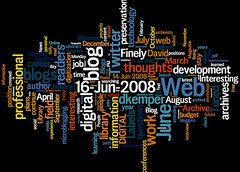
digitalpermanence Tags
Originally uploaded by siansleep
This is The DIGITAL Archive. Now this is The DIGITAL Archive on, er, well, on wordle.net.

Go to wordle.net and you will understand what I mean.

Thursday, June 19, 2008

4 Steps to Building an Online Profile

As more users participate in the social web, partaking in social networks for personal and often professional reasons, I think it is important to write a simple, practical, and representational online profile, particularly if users are seeking to attract new clients or potential employers.

The following are guidelines I developed to help you compose an online profile. To remember them quickly, think "The 4 F's": FORMAL, FACTS, FUNCTIONS, and FUN.

Let's start!

1) FORMAL: State who you are, in either first or third person, using either your current job title or your professional title, giving some emphasis to your area of speciality. Briefly.

For example:

I am an electronic records manager, focusing on managing digitized records and enterprise resource planning data;

OR

Robert Grant is an electronic records consultant, supporting clients transition from paper to digital records

2) FACTS: State your educational qualifications and work experience. Briefly.

For example:

I have a B.A. in History, B.Sc. in Computer Science, and a Master of Library and Information Studies, with 4 years work experience in an educational institution and a medical library

3) FUNCTIONS: State what you have done in those years of education and work experience. Briefly.

For example:

I designed and implemented a new taxonomy and trained staff and senior administration;

OR

Robert Grant has re-designed several websites, improving navigation and content accessibility, and making these websites the hub of information delivery

4) FUN: Express your personality using the most succinct and passionate words that describe you, while explaining how these qualities enrich your work. Ask family, friends, professors, employers (past and present), if necessary.

For example:

I am a creative, innovative, and team-oriented individual, whose passion for people, technology and libraries direct my decisions and work ethic.

Use The 4 Fs wisely, and add your own uniqueness to them, and I am certain your online profile will get noticed.

Wednesday, June 18, 2008

Vincent Cerf Gets It!

From the Special Library Association (SLA) conference, being held in Seattle from June 15-18, SearchEngineWatch.com reports that Vincent Cerf, Google's Vice-President, expressed concern over the state of digital preservation.

In an interview with Charlie Rose held at the SLA Conference, Cerf said "he’s deeply concerned about digital preservation and the 'born digital' challenge; he hopes to avoid a 'bit pile' of inaccessible, extinct content and urged companies to open up development for digital preservation applications."

Vincent Cerf gets it!

Will companies, organizations, institutions and hard-headed, stubborn senior admin types also get it?

Of Facebook and Friends

A few months ago, after several promptings by colleagues, I decided to join Facebook, the hugely popular social networking website. I was hesitant to join because I had seen another successful social networking website, MySpace, and was repulsed by its noisy layout and design. However, Facebook seemed different—more streamlined, more accessible, I guess you could say—and for the not so easily impressed critic inside me that was enough reason to take the plunge.

Besides, I thought, I could connect with a few old friends.

But my introduction to Facebook was more sobering than anything else.

In a matter of minutes, I discovered two friends who had been my best friends when I was a kid. These two guys were the best. We were all roughly nine years old, give or take a few months between our birthdays. We’d go bike riding around the neighbourhood from dawn ‘till dusk; we celebrated birthdays; we’d set out for adventures downtown, where we’d catch a few movies; and we’d play sports, like street hockey or parking lot baseball, on the weekends and during the summer when school broke for holidays.

The summer sun was endless, the fun was endless, and life was sweet. We enjoyed this life for many, many years until circumstances, such as college, work, and family relocation, slowly took us into different directions. We lost touch, for the most part, only seeing each other briefly at university (in the halls) or on the bus or train.

But I never forgot those guys or those days. How could I? Can one really forget those days, when one was nine years old? I loved them; I loved us, those crazy kids on their bikes, innocent, without a single care in the world other than finding out the time for our favourite cartoon show and the release date of the latest Nintendo video game.

On Facebook, however, I barely recognized their faces. The oldest member of our trio was–let me call him “Big T”—was the sports fanatic and music lover. He introduced me to baseball as well as to hip-hop music (KRS-One, Boogie Down Productions, remember them?). As a kid, “Big T’s” dream was to become a professional baseball player and a rapper. He had a passion for both.

In checking out his Facebook profile, and in chatting with him, he had become an occupational therapist by day and a Deep House music DJ by night, hosting his own late night/early hours show on the Internet. His passion for music never waned, only transformed into something different. His passion has made him widely recognized and well-travelled. Awesome!

Meanwhile, the youngest member of our trio – let me call him “Lil L”—was the book reading, D&D playing, adventure-seeking free spirit. He introduced me to role-playing games (D&D, AD&D, RIFTS) and to the then still embryonic world of PC games (the hilarious Space Quest series). We’d bike a lot together, through forest paths, getting bitten by mosquitoes, and to the outer limits of our neighbourhood, which was very far for our little kid navigational senses. His mother would take us to baseball games and museums and his grandmother would serve us lemonade and share her air-conditioned apartment on especially hot and humid summer days.

As a kid, “Lil L,” much like myself, loved role-playing games. We loved conjuring up stories for our role-playing characters. The more stories we made up, the more fun we had. Personally, I found making up stories and watching friends become engrossed very satisfying, as I often came up with one story after another. Some good, some duds, and some with the right mixture of mystery and action that I even surprised myself. At one point, during one of those tension-filled story moment, “Lil L” asked me, “How do you come up with all these stories?” It was a question I could not answer. I was afraid to answer. I didn't quite know; they just came. But the question stuck with me for many years. My imagination, it seemed, was rearing its newborn head.

On Facebook, I honestly could not recognize “Lil L” because the profile image I saw was that of a man carrying a baby. The shiny kid face I had known was replaced by a glowing fatherly face, complete with goatee and sunglasses, and in his arms he held his child. “Lil L” was married with two young boys and worked with a large telcom company. His wife was not the girl who he had an endless crush on as a kid, but someone else. His two boys had their father’s free spirit look (in a few short years, I thought, they will be biking around the neighbourhood from dawn ‘till dusk).

Sadly, I also learned that his mother, who had set up birthday parties and trips to baseball games, had died a few years back. I could not swallow that revelation. I had known her, and now she was gone. Not sick or ailing, but dead. I was stunned, shocked, in disbelief. And as clichéd as it may sound, I felt something die in me.

This is not what I expected from Facebook. I expected connecting, social networking, old friends, new friends, super walls and super pokes. Instead, I experienced sad, painful nostalgia.

The faces I remembered were from a different time; the faces I now saw on Facebook were changed by time and circumstances, for better or for worse. And the time we had known together, that I had known so thoroughly and enjoyed immensely, which I kept tucked away safely in a protected memory center, to be retrieved every so often, had moved on.

I clicked logout, something I would often do in the months after I joined Facebook. And I never bookmarked the website.

Nowadays, I hardly use Facebook. That’s not to say Facebook has no value in the future. But for me, at this time, I am content with the social networking websites and tools I use and the online friends I have. I do not wish to allocate any more time to Facebook.

If one of Facebook’s purposes was to assist users reconnect with old friends with a few clicks, it certainly succeeded. Though not its fault, Facebook simply failed to mention that a few clicks can also mean opening doors to the past that, in retrospect, should be approached cautiously and in some cases sometimes remain closed.

Tuesday, June 17, 2008

The Birth of the Web Ego-Maniacs

I am noticing a troubling trend among the user-created content set. Don’t get me wrong, I am a strong supporter of user-created content, particularly when it is well-produced, entertaining, educational, and engaging and exhibits the fundamentals of Web 2.0 (social).

There are numerous websites (and more on the horizon, I bet) that enable users, like you and me, to publish our thoughts and ideas. There are blogs, naturally, wikis, photo-sharing sites, and, as broadband surges forward, the proliferation of podcasts and videoblogs.

Equipped with a laptop, web camera (or a camera-enabled cell phone), and a high-speed Internet connection, one can record shows or even broadcast live across the Web. There’s Youtube, of course, and there is Y!Live, Ustream.tv, Viddler, Vimeo, Qik, Kyte.tv, Flixwagon.com, and many more. All worth checking out, if you like.

But I am seeing a trend that I do not like among these websites:

First, I am seeing the same user faces across all these websites. It’s as though a dozen or so of these pro-bloggers or pro-vloggers are taking up much of the space and sadly with some less than stellar material. I don’t want to name names, although I assume some would not mind the additional attention.

Secondly, the material that is being produced, while "live" and "dynamic" (yeah, crossing the street, yeah), is for the most part pointless and trivial. Enough with the crap! You’re clogging up the arteries of the Internet with these narcissistic, self-indulgent videos.

Mind you, I am not condemning these top bloggers and vloggers, these shameless pluggers, because they are largely friendly folks with good intentions and some have found a recipe for success, being able to make a living off this new media lifestyle. These top vloggers have their good moments, true, but they should save their ramblings, pontifications, and walks through their basements and their freak-outs for their personal hard drives, not the Web.

Monday, June 16, 2008

How Blogs Can Save Your Career

Earlier this week I had lunch with a friend, a fellow library school grad. We had a conversation about professional development…or the lack thereof. We both graduated in the same year and we both had a roller-coaster ride during our first years in the library and information field following graduation.

While he has found himself as a librarian in a documentation centre and I continue to carve out a new career path altogether, we both agreed that professional development in the field (or any field, for that matter) had to improve.

“Aside from attending a few local conferences,” he explained, “I haven’t done much or learned much. I just do what I have to do at work. That’s it.”

I was shocked by his indifference. “So what do you do to stay current?” I asked.

“I read a few journals, but that’s about it.”

I told him that I had attended roughly 4 conferences / seminars / workshops in my 8 year career. And I bemoaned the fact that I had I wanted to attend more to learn, to connect, to meet with my peers, but was thwarted by a number of setbacks, including the usual limited budget.

Placing the blame on the usual suspects, such as limited funds, indifferent employers, or the limitations imposed on contractual positions, can often alleviate the frustration, but it does not erase the truth: professional development is a must.

In 2002, Barbara Quint, editor of Searcher Magazine, wrote a very insightful column in the July/August issue of the magazine. In reflecting on her career path, and offering advice to her readers, she stated boldly:

“When an information professional stops learning, they start dying, or at least their career does. And any information professional in this day and age, with all the changes upon us and more coming, who does not or cannot allot a significant portion of their work time to learning and study will not be able to perform well the job they have now for much longer, much less the future jobs they should have.”


I agree 100% With contractual positions, as I have been in over the years, the employer’s interest, for better or for worse, is to ensure the work he or she has planned gets done, not necessarily to support the professional development of the person hired.

So what should one do?

As I walked down the bustling streets, I was caught in my thoughts, wondering how I have managed to stay current (more or less) despite being on contracts or, more recently, unemployed.

One word kept surfacing: blogs.

Seriously, if it were not for the many library and archives, Web 2.0, new media, digitization, digital preservation bloggers and social networkers on the Web, I would be far, far behind the curve.

It is thanks to those who, in the spirit of sharing, write and talk about their work, projects, ideas either daily, bi-weekly, weekly or monthly that I have been able to stay current in the field.

I hesitate to list the blogs I read, so as not to alienate anyone, but my blogroll is to the right, and I continue to add to the list.

I believe in the power of blogs, their immediacy, their intimacy, and their uncanny ability to auto-generate communities, because I know I have benefitted from them and learned from them. And continue to do so.

For example: How did I find out about Twitter? Through a podcast I heard. How did I find out about the latest happenings in education and libraries? Through several bloggers whose daily commentaries are food for thought. What prompted me to be concerned about blog preservation? The many mil-blogs out there whose posts chronicle the story of soldiers in Iraq and Afghanistan. There are many more examples.

Professional development involves participating in several areas. Make sure the blogosphere is one of them. You never know who you are helping.

Sunday, June 15, 2008

Interesting People, Interesting Blogs (Part 9)

The latest blog to be inducted into the coveted "Interesting People, Interesting Blogs" category of The DIGITAL Archive is Lynne M. Thomas's "Confessions of a Curator," which, in the author's words, is "a blog about Rare Books and Special Collections at Northern Illinois University."

Hey, check it out!

Tuesday, June 10, 2008

Job Search: Interview Questions

In the course of searching for employment, there comes a time (or, if you're fortunate, several times) when one is called in for a job interview. In a job interview one or two staff members, or perhaps even a large committee, sits you, the applicant, down in a room and asks you some fairly standard questions about yourself, your skills, your strengths and weaknesses in addition to your past achievements and future plans.

With preparation and practice, one can become very confident in answering these questions honestly and positively.

However, one part of the questioning that often disrupts my flow is the one where the interviewers ask me if I have any questions.

Naturally, the applicant should ask about salary, benefits, vacation time, etc. But this, I believe, should come a little later. First, there must be some clarifications concerning the job itself.

After some brainstorming, I've developed a few questions that could be asked of the interviewer. Send me your comments if you have additions.

1) What is/are the main role(s) and responsibilities of the position?

2) Describe for me a typical day for the person in this position?

3) What are the primary and secondary goals and objectives of this position?

4) What is the budget for projects, such as hardware and software?

5) What is the budget for attending conferences, workshops, etc (i.e. learning opportunities)?
UPDATE: Via Michael Stephen's Tame the Web blog, I found an interesting article in Library Journal written by Michael Casey and Michael Stephens. It is about finding a library job that fits your values. Whether you are contemplating a library or a factory, the article brings up some good points. I am glad the authors mention the importance for library administrators to promote staff development, among other things. Please do read the article.

Monday, June 09, 2008

Twitter Goodness For Information Professionals

It's no secret, the world's favourite microblogging tool, Twitter, has been experiencing some technical problems as of late.

But have no fear, with today's Apple Worldwide Developers Conference (WWDC), Twitter plans on strengthening its infrastructure and boosting system performance. (Fingers crossed, fingers crossed.)

In the meantime, enjoy some Twitter goodness:

1) Twitter for Librarians: The Ultimate Guide

2) Summize - Search Twitter in realtime, searching conversations. Yeah!!

Friday, June 06, 2008

The Friday Abstract: Suite Online Mischief

From the department of "Who needs Microsoft Office Anyway" I discovered Adobe's Acrobat.com online office suite (via ReadWriteWeb). For an online office suite, it looks very promising. If you wish to sample, you first must register. Don't worry, it's free. BTW, read Adobe's Acrobat.com blog for further news.


about the author

I am an information professional, researcher, and writer with over eight years experience in the information services field with experience in information and communication technology.

I have a B.A. in History and a Master's in Library and Information Studies and working on a Web and Multimedia Design certificate.

I believe that empowering people with information can enrich lives and transform the world.