It appears that my Alma mater at the McGill Graduate School of Library and Information Studies are looking for a Professional Associate to teach a graduate-level course ("Web Design and Management") and to maintain the School's IT lab.
I know the person who has held on to this position for the past couple of years, and I am pleased to hear that he is moving on. On a personal note, this person also helped me land my first LIS-related job at the McGill University Archives.
In other news--good news, thankfully--I almost fell out of my computer chair when I read that Ed Bilodeau will be moving to Ottawa, Ontario, with his wife-to-be Nathalie, to work as a Web Administrator at Carleton University. Congratulations, Ed! That's great news!
I know a few faithful readers out there may be wondering: "That is great news - but what about you, O Great DIGITAL Archive blogger? How are things on the job search front?"
Nothing much new to report.
But I will tell you the honest truth: The more positive news I read from fellow bloggers, the more clearer the path ahead looks to me in terms of career direction, relocation plans, and so on. The good news makes it no less easy in solving problems, of course, but somehow it gives a new perspective to resolving them.
In the meantime, I am almost finished with the hospital libraries' website re-design project. In a few weeks time, I hope to post a URL to them once they are placed on a production server.
Sunday, July 30, 2006


Thursday, July 13, 2006
Did you know: Adobe Acrobat a RSS reader
If you have Adobe Acrobat Professional 7.0, follow these steps:
1. From the menu bar select Comments --> Tracker...
2. A Tracker window opens up. From the menu bar on the Tracker window select Services --> Subscribe
3. A new pop-window opens asking you to insert a RSS feed URL
4. Voila! RSS news feed in Adobe Acrobat. You can even convert a news items to PDF. Select Services --> Convert to PDF
Wednesday, July 12, 2006
GIS Junkies!
GIS (Geographical Information System) junkies listen up! (And all you Google Maps addicts out there lend an ear as well.)
Natural Resources Canada's Canadian Forest Service (CFS) has launched (in typical quiet low-brow Canadian fashion) an online service called Forest Fire in Canada.
It is a powerful information system that combines the power of geographical information-gathering and remote-sensing of ground activities to create a comprehensive picture of forest fires occurring across North America.
It's no longer just about fighting fires - it's about fire management. Knowing and understanding how forest fires will affect the socio-economical landscape of the country.
Check it out: Forest Fire in Canada.
Friday, July 07, 2006
Job Search: Preliminary Results
A few weeks ago (or perhaps a few months ago - I'm not so sure now), I wrote a post about my intentions of using this blog to establish a network of colleagues in order to find a job in the library / information management field. It was an experiment, of sorts, to test the power of the blog.
I gave a brief description of my background, and I also uploaded my resume to give people a chance to view my skills, knowledge and work experience.
While the experiment is still on-going, I have decided to examine some of the preliminary results:
One person, so far, has responded directly to my resume. This particular person, it should be noted, shares an interest in digitization and digital projects. I thank her for taking the time to respond and for providing me with further information.
This is worth reflecting on for a minute, for it demonstrates how a blog should be used in order to effectively network. Here are my thoughts:
1. Don't give up; keep blogging; have a topic in mind
Like our solar system, populated with its nine distinct planets, a blog can be filled with several different topics. But it is always a good idea to have one topic--one sun, if you will--around which everything else revolves.
Topic-specific or project-specific blogs (as this one, The DIGITAL Archive, used to be and still yearns to be) garner a fair share of attention because they focus on topics that are, professionally-speaking, of interest to people in the same field, in the same area of research. If one can use one's blog to contribute to the larger blogosphere discourse on a particular topic, chances are that blog networking opportunities will arise.
2. Building a blog network takes time.
Rome was not built in a day, nor will a blog's audience. It requires time and effort as well as patience.
3. Mention and cite blogosphere colleagues.
Frequently we come across a blog post that resonates with us. We consider and even savour the post's contents. Why not simply mention the post and the blogger's name the next time we make our own post? Let them know we read their post, and in turn they will know we are out there.
I think we all, from time to time, do a bit of "egosearching" (the act of searching for references to one's blog, as Gary McGath aptly put it), and in doing so we do indeed find more people with similar interests who have cited us in their blog. Our blog network grows.
4. Blogs are for sharing and communicating information.
This is worth repeating: Blogs are for sharing and communicating information. We are social creatures always seeking new ways to express ourselves. Blogs are a new and highly interconnected way of doing so.
Stick with the basics - blog about what stirs your enthusiasm - and amazing things will happen!
Tuesday, June 20, 2006
Slow news day?
Apologies for not posting too much new material lately.
The web re-design project that I am currently working on is in full swing and taking up most of my time.
The web re-design project that I am currently working on is in full swing and taking up most of my time.
"No, it's much better to face these kinds of things with a sense of poise and rationality"
The NHL Stanley Cup finals ended last night Monday, with the Carolina Hurricanes seizing Lord Stanley's famed trophy after beating the Edmonton Oilers in 7 hard-fought games.
Coming from a huge hockey town as Montreal, I want to send my congratulations to the people of Raleigh and all fans of the Hurricanes - it was definitely a series filled with skill, talent, and lots of heart.
So rather than rant and rave over the fact that a Canadian team was unable to take home the Cup, I will, as that Panic! At the Disco song goes, "face these these kinds of things with a sense of poise and rationality."
Monday, June 05, 2006
Job Search: Technical Snafu Solved
A special thank you goes out to Jill Hurst-Wahl (blog: Digitization 101) who pointed out to me that the link I posted directing users to my resume was in reality sending folks to an error message web page rather than to my illustrious (read: humble) resume.
Seems like the hosting company I used changed its policies.
No fear. The experiment continues, now with help from Google Pages. Yes, Google. We cannot escape them.
For those interested, my resume is (for the time being) here.
Seems like the hosting company I used changed its policies.
No fear. The experiment continues, now with help from Google Pages. Yes, Google. We cannot escape them.
For those interested, my resume is (for the time being) here.
Saturday, June 03, 2006
The Web: CBC.ca redesign!
Browsing along the information highway in attempts to find more news on the 17 terror suspects arrested in Toronto early Saturday morning, I came across the new and improved CBC.ca website.
After 6 years, the Canadian Broadcasting Corporation along with its French counterpart, Radio-Canada, have undergone a website face lift. Looks good. Fancier than before. But a little crowded.
See for yourself: CBC.ca or Radio-Canada.
After 6 years, the Canadian Broadcasting Corporation along with its French counterpart, Radio-Canada, have undergone a website face lift. Looks good. Fancier than before. But a little crowded.
See for yourself: CBC.ca or Radio-Canada.
Wednesday, May 31, 2006
Remembering our Veterans
One of the last (and perhaps most gratifying) projects I worked on before I resigned from McGill was a physical and virtual exhibit on McGill students and staff who served during the Second World War, a project that coincided nicely with 2005's "Year of the Veteran" in Canada.
The project culminated on November 11, 2005, Remembrance Day, when a moment of silence was observed and the exhibit revealed, both online and inside McGill's famous Arts Building.
I wrote a brief announcement (a few weeks later, it seems) about that day's events. The virtual exhibit, meanwhile, is still available online.
All that to say, today, I heard on the news (courtesy of CJAD radio) that the Quebec Government will rename a major Montreal highway to "Remembrance Highway" in honour of our veterans' service and sacrifice. Awesome!
Quebec Government is renaming Highway 20 to Rememberance Highway
If you're heading home to the West island right now there's a good chance you're taking "Autoroute du Souvenir."
What the heck is "Remembrance Highway" you ask?
It's what Highway 20 used to be called.
The Quebec Government is renaming Highway 20 between the Turcot yards and the Ontario border in honour of our veterans.
The Quebec Provincial Command of the Royal Canadian Legion says they've been fighting for the change.
The name change is immediate but no word on when the new signs will go up.
Tuesday, May 30, 2006
Interesting People, Interesting Blogs (Part 4)
I found yet another noteworthy blog. File Formats Blog is a blog by Gary McGath, a Digital Library Software Engineer at Harvard University Libraries. His blog focuses on "news and comments about technical issues relating to file formats, file validation, and archival software."
If you are interested in the digital preservation of file formats and examining solutions that will (hopefully) stand the test of time, then this is a blog for you.
If you are interested in the digital preservation of file formats and examining solutions that will (hopefully) stand the test of time, then this is a blog for you.
Monday, May 29, 2006
Interesting People, Interesting Blogs (Part 3)
I came across yet another interesting blog; it is called "Annoyed Librarian." According to its author, the Annoyed Librarian blog "satirizes librarians, librarianship, and the ALA [American Library Association]."
This blog is by far one of the most witty, sharp, acidic, satirical--and essentially politically-incorrect--blogs about librarianship that I have ever come across.
The writer is clearly articulate and systematic in her (the writer is female) critique of the field of librarianship. Everything from library school and MLS degrees to job postings and salaries are examined in a tongue-in-cheek but ultimately brutal manner.
Saturday, May 27, 2006
What's up with Blogger?
I know this may sound as though I am biting the hand that feeds me (or, rather, make that, the provider that allows me to blog), but I find that Blogger has been plagued by problems lately.
Last night I was unable to save some changes I made to my blog's settings. That problem, thankfully, was resolved this morning. Meanwhile, I cannot use the BlogThis! feature when I come across an interesting article, new items, or whatever that coincides with my research for this blog or for archivius. And there have been other issues as well, mainly dealing with blog publishing problems.
One valuable website to keep in mind is Blogger Status - it keeps bloggers up to date on problems, fixes, and other maintenance issue occurring in Blogger land.
Another valuable resource is Blogger Forum - a forum for bloggers, specifically Blogger users.
I don't know if Blogger intends on buying new servers or what, but I certainly think a thorough review of the system is in order.
Sunday, May 21, 2006
Blog Power: My Job Search
Since March of this year, right after my departure from McGill, I have been trying to secure a sense of direction--a sense of mission--for both my career as well as for The DIGITAL Archive. I have been thinking about both of them, and came to the conclusion that perhaps both could benefit from each other.
Therefore, I will endeavor to test the power of the blog.
I hereby make my intentions known to my readers: I am looking for employment. Yes, a full time library/archives/information center job. Sounds nuts, this approach. But, why not.
Here are my 3 main assets (a more detailed list can be read on my resume):
I covered several important and emerging areas during my tenure such digital asset management, records management and digital content policies (please see my resume).
I increased the visibility of my department by creating an aesthetically-pleasing, engaging, and comprehensive web presence (please visit the website I designed and managed at McGill to gain a clearer picture).
In each case, I brought to my role and my areas of responsibility dedication and, in all honesty, I real sense of innovation, of thinking differently in the face of old problems and new challenges (please see my resume).
Bottom line is: I'm looking for an opportunity to contribute meaningfully and learn.
So is everyone else, right? Well, that's why I'm testing the power of the blog. I don't know how many readers I have. Maybe I only have one constant reader. According to my little ClustrMap widget down on the left column, I have visitors--potentially readers--from North America and across the globe. Maybe someone knows someone who knows someone who is, say, working in a college or university, and is looking to hire a qualified person with the skills I have.
Maybe...
This is an experiment. So let's give it a go.
Thanks for reading!
Therefore, I will endeavor to test the power of the blog.
I hereby make my intentions known to my readers: I am looking for employment. Yes, a full time library/archives/information center job. Sounds nuts, this approach. But, why not.
Here are my 3 main assets (a more detailed list can be read on my resume):
- I have a professional master's degree (MLIS)
- IT skills, with a focus on web design
- 5 years work experience in a large university library and archive
I covered several important and emerging areas during my tenure such digital asset management, records management and digital content policies (please see my resume).
I increased the visibility of my department by creating an aesthetically-pleasing, engaging, and comprehensive web presence (please visit the website I designed and managed at McGill to gain a clearer picture).
In each case, I brought to my role and my areas of responsibility dedication and, in all honesty, I real sense of innovation, of thinking differently in the face of old problems and new challenges (please see my resume).
Bottom line is: I'm looking for an opportunity to contribute meaningfully and learn.
So is everyone else, right? Well, that's why I'm testing the power of the blog. I don't know how many readers I have. Maybe I only have one constant reader. According to my little ClustrMap widget down on the left column, I have visitors--potentially readers--from North America and across the globe. Maybe someone knows someone who knows someone who is, say, working in a college or university, and is looking to hire a qualified person with the skills I have.
Maybe...
This is an experiment. So let's give it a go.
Thanks for reading!
Friday, May 19, 2006
Thinkfree: Freedom to Office anywhere?
On a wet rainy day like this (at least in this part of the Canadian woods), I am glad I came across a new Web gem (via Will Richardson's Weblogg-ed): it's called Thinkfree.
According to the company's website, "ThinkFree is the leader in next-generation productivity solutions for platform independent, anytime, anywhere-computing. ThinkFree usability extends beyond PCs and is perfect for Internet-connected devices, including thin client and mobile computing platforms."
The company also explains that its online software can create 100% compatible Microsoft Office documents.
Besides that, it appears that you can add documents to your blogs and append your Flickr images to your documents as well. Cool.
I haven't registered yet. I'll will give it a try soon. But, in the meantime, if you do register, let me know what you think.
Wednesday, May 17, 2006
Blog editor tool for Firefox
I am always interested in testing and using new software. Case in point: Performancing, a Firefox extension that allows bloggers to post directly to their blog from their Firefox browser.
Well, let's give it a try.
Well, let's give it a try.
Friday, May 05, 2006
Friday Fun: Korean Scientists Develop Female Android

From the Korea Times (yes, I read 'em all), this perfect Friday afternoon story (at least for a sf/futurist guy like me):
Korean Scientists Develop Female Android
Friday, April 28, 2006
Interesting People, Interesting Blogs (Part 2)
I came across a few more bloggers that I believe are worth reading.
What I Learned Today... is a blog by Nicole C. Engard. She explains that her blog is about "Web 2.0 and programming tips from a library web manager." It covers "blogs, rss, wikis, php programming and more as they relate to libraries." A lot of good techie stuff.
For readers out there who speak and read French, I came across Figoblog, a blog about the Internet, librarianship, and "la confiture de figues." (Rough translation: fig jam.)
Figoblog appears to be based in France, but he/she is fully immersed in what's going on around the world regarding digitization and digital preservation (hey, Figoblog even linked to my post on the preservation of blogs.)
Aaahh, the power of blogs.
Tuesday, April 25, 2006
Interesting People, Interesting Blogs
In between scanning job sites and updating my resume this morning (ho-hum), I came across a blog by Eric Lease Morgan, Head of the Digital Access and Information Architecture Department at the University Libraries of Notre Dame (bio here).
Morgan's Infomotions, Inc. blog/consulting website offers some interesting insights--or musings, as he calls them--on library technology and its impact on delivering information.
More writings:
Morgan's Infomotions, Inc. blog/consulting website offers some interesting insights--or musings, as he calls them--on library technology and its impact on delivering information.
More writings:
Sunday, April 23, 2006
Career Reinvention
I read an interesting article in the Montreal Gazette's "Working" section the other day ( Saturday, April 22, 2006) called "Dive right in."
The article focuses on and discusses the points mentioned in a career planning book titled Working Identity: Unconventional Strategies for Reinventing Your Career by Herminia Ibarra, a former teacher at Harvard University, now a teacher at INSEAD, an international business school in Fountainbleau, France.
Ibarra's argument runs contrary to traditional career advice; she recommends that people wanting a career change or wishing to reinvent their career paths should go out there and do it rather than plan every little detail before acting (lest paralysis by analysis settles in, that's my additional opinion).
Considering the career roller-coaster ride that I am currently on (I resigned from my job in March, am now working as an independent web consultant and web designer at a downtown hospital, but still looking for better), I think the article, the book, and the thoughts the author puts forward are well worth mentioning in The DIGITAL Archive.
I suspect this blog may have a few library or archival studies students, as well as a number of established librarians, archivists, and information professionals, who may be seeking a (new) career direction or who are in the midst of reinventing their careers.
I think this post will be worth your time.
Before I dive in to the "Dive right in" article (no pun intended), I want thank one blogger by the name of Will Richardson whose educational blog Weblogg-ed: the read/write web in the classroom first shed light (to me at least) on the concept of reinventing one's career. Browse on over to his February 7, 2006 posting in which he announces his decision to leave his current job to pursue "(a)nother path, one that I hope leads to satisfying, engaging, urgent work. Urgent work."
I really like that line!
OK, now on to the Montreal Gazette article...I wish I could add a URL here, but unfortunately the Gazette has locked this article, making it only available to online subscribers.
For those with access to an online newspaper database, try searching for "Dive right in" and "Strategies to reinvent your career" by Donna Nebenzahl, Montreal Gazette, Saturday, April 22, 2006.
Herminia Ibarra, author of Working Identity: Unconventional Strategies for Reinventing Your Career, suggests 9 "unconventional" strategies for reinventing one's career.
- Act, then reflect - You cannot discover yourself by introspection. (I think French author Albert Camus made this point in his novella The Outsider).
- Flirt with yourselves - Stop trying to find your one true self, she recommends. Test out your various selves, your various ideas, in the real world, where concrete behaviour and feedback give you new insights.
- Live the contractions - A little unclear this one, but she suggests one allows oneself to oscillate between holding on and letting go of ideas when in the midst of transition.
- Make big changes in small steps - Don't make big sudden changes, she argues. Like the construction of a sky-scraper, take one small step at a time in re-building your career.
- Experiment with new roles - Try out new roles or styles of working by pursuing them as extracurricular activities. Vary experiments as much as possible to get as much feedback as possible.
- Find people who are what you want to be - Look for role models.
- Don't wait for a catalyst - Don't wait for some big event to reveal your true calling (dang, no Luke Skywalker moment, folks). Use everyday events to find meaning in your transition period and soon clarity will occur.
- Step back, but not for too long - Take a break from the norm and away from that which is familiar. A day's hike or doing something that removes you from the usual surroundings are useful moments to reflect.
- Seize windows of opportunities - Take advantage of windows of opportunities as they open.
Wednesday, April 12, 2006
Time for some R and R
I noticed that I have not been posting much lately.
Perhaps there's not a lot to say at the moment. Perhaps the DIGITAL Archive is undergoing some growing pains (the DIGITAL Archive was a project-based blog, detailing a specific project I once worked on while employed in the McGill University Archives).
Maybe that could be the reason.
Or perhaps it's just a slow news day, as they say in the journalism business.
Well, rather than filling this space with, well, filler, I think I will take some time to off - a break from the blogosphere.
Actually, make that a break from blogging - I will still find time to read other people's blogs since I find those I subscribe to interesting and informative.
Also, there is still work to be done: the medical library website re-design project continues. As well as my on-going job search.
It's been touch and go--the job search, that is--since March 3, 2006, the day I ended my time at McGill. Not sure why it's been so rough. It's been tough enough that I often wonder and question my future in the archival/library/information field. As far as I am concerned, librarianship is a difficult field to enter, a tough nut to crack.
Although I feel a little discouraged, I nonetheless hate ending a post on a negative note.
It's Spring out there, folks. The sun stays out longer, the grass is getting greener - at least in this part of the Western hemisphere.
Time to take some r&r: a little rest and relaxation.
Surely, summer--and brighter days--is right around the corner.
Thursday, April 06, 2006
Blog Item: Health Problems Related to the Geek Lifestyle
If you suffer from the following health conditions, you might be a geek:
1. Poor Sleeping Habits
2. Headaches
3. Back Pain
4. Poor Attention Span
More >>
Health Problems Related to the Geek Lifestyle » Carotids.Com
1. Poor Sleeping Habits
2. Headaches
3. Back Pain
4. Poor Attention Span
More >>
Health Problems Related to the Geek Lifestyle » Carotids.Com
Wednesday, April 05, 2006
...And we're back!
Yes, I am back, after several days away from the blogosphere; and I am back with a very good posting that I read on Jill Hurst-Wahl's Digitization 101 blog.
The posting focuses on non-traditional career paths for librarians. It's a nice piece, full of insight and information for librarians and information professionals who seek to pursue a, well, non-traditional career path.
Overall, the posting covers a lot ground, but it's all good.
With my university archives experience and now my web design work in a medical library, I definitely fit the description of someone wanting a career path that differs from the norm - one that realizes the value of information, embraces technology in its many evolving forms, and makes a connection with and helps people along the way.
I truly believe this library/information field is going through some major changes and challenges. On the one hand, the future of the field is dependent on it transforming itself to face new realities; but, on the other hand, are library school's across Canada and the United States teaching the next-generation set of skills, let alone aware of them?
I wrote about this in an article that was published in the American Association of Law Libraries (AALL) Spectrum magazine (October 2001). (Shameless plug.)
On a side note, the Digitization 101 posting also mentions an article in Searcher magazine (July/August 2002) called "A Resume that Works." That article (and the entire issue, for that matter), is one of the best information professional magazines I have read. Try and find a copy!
Saturday, March 25, 2006
Rusty Gears Turn Slowly
CREAK!! HTML.....HEAD......TITLE.....
CREEEEAAAK!! #container {width: 770 px...
You hear those rusty web design gears turning? I sure did since starting a new web re-design project at one of McGill's affiliated teaching hospitals (part of the super-hospital entity known as the McGill University Health Centre (MUHC)).
All last week they were slowly turning and shedding bits of rust in my head as I sat down I talked with the head librarian of the Medical Library and reviewed his website plans.
I will need to give myself a few days or even a few weeks to become re-acquainted with the technicalities and peculiarities of HTML and CSS.
Still, I cannot help but sense that same feeling, which prompted me to leave my previous job, slowly stirring in my gut, cautioning me that this project is but a pit stop on the highway I have chosen to take. This highway, unfortunately, has no Google Map available. It's just the road ahead.
Please note the bottom right column, where I have stationed a neat-o del.icio.us bookmark module. Keep an eye on as I continue to bookmark relevant digitization news that I come across.
Also, please check out archi.vi.us, my attempt at creating a social bookmarking blog about all things Archives 2.0 (yeah, I'm adopting the lingo, Web 2.0, Library 2.0, etc).
Archives 2.0? It's about digital archiving, digital preserving, digital collecting, digital sharing of archival information. It's a work-in-progress, so bear with me if updates over there are slow and far between.
Wednesday, March 15, 2006
Job Search Update
Thankfully, I will not have to dwell for much longer in this state of unemployment, which started back on March 3 when I decided to resign from my position in the McGill University Archives.
To make a long story short, I received a phone call a few weeks ago from the head librarian at one of McGill University's affiliated teaching hospitals in downtown Montreal. The head librarian, with whom I did some volunteer work in 2004, is re-designing the library websites under his direction, and he proposed a temporary contract position for me to analyze and evaluate the websites' current information architecture and then develop a newer, more flexible architecture along with a better navigation system and a cleaner design and layout.
I accepted and will start on March 20 (quite an auspicious date, considering I know of more than one person starting anew on this date as well), and I will be dividing my time between the hospital and home. In both cases, I have a respectable set up to run the necessary Web software applications such as MS Word, Dreamweaver, and Photoshop.
Fortunately, I will not have to dust off my college-level Biology 101 text books or earn a certificate in health informatics - his staff will be working on the content. But I will need to dust off my HTML and CSS text books, although nowadays it is XHTML\CSS, with CSS not only handling formatting but page layout as well.
Anyone know of a good CSS layout book, tutorial, or online resource?
It has been close to 2 weeks since I resigned, and I have been trying to focus on the proverbial long-term career plan, but all to no avail. I will take this new and very different job opportunity to open up more doors, more so in my mind than literally. Friends and colleagues have told me to rest my mind and not to jump into anything too quickly. I'll try to follow their advice.
Meanwhile, stay tuned - the DIGITAL Archive is working behind the scenes at the moment, tightening up a few gears and adjusting the vertical and horizontal controls.
We'll be back on the air soon.
Thursday, March 09, 2006
Top articles of 2006 (so far)
According to the RLG bloggers at hangingtogether.org, the following are some of the best articles written on the topics of digitization, digital preservation, access, etc.
In no particular order, here they are:
In no particular order, here they are:
- "Changing a Cultural Icon: The Academic Libray as a Virtual Destination" by Jerry D. Campbell
- "The (Digital) Library Environment: Ten Years After" by Lorcan Dempsey
- "Research Libraries Engage the Digital World: A US-UK Comparative Examination of Recent History and Future Prospects" by Clifford Lynch
- "Excuse Me...Some Digital Preservation Fallacies?" by Chris Rusbridge
Project Origami: Microsoft's Ultramobile PC Launched

I caught wind, or rather the tail-wind, of the hype surrounding Microsoft's newest product (code-named Origami) somewhat late, so waiting on its release date (March 9) did not take too long, thankfully.
Microsoft is launching today its Ultramobile PC (UMPC). The official Microsoft site is here. Meanwhile, the Flash-powered "Project Origami" hype site is here. USA Today's Tech Product section has a good overview of the UMPC.
I took some screen shots as well.

I can't say I am overly impressed by Microsoft's efforts. The UMPC has an uninspired design and a kind of bulky (read: clumsy) look and feel to it. Microsoft's main consumer product competitor, Apple, should not feel threatened.
However, I must give credit to Microsoft:
Like 'em or hate 'em, Microsoft is capitalizing on an ever-growing and paradigm-shifting trend: digital mobility.
We see this powerful trend daily in the cell phones people of all ages use; we see it in the number of wi-fi enabled laptops and notebooks professionals carry around; we see it in the iPods and other mp3 devices people listen to on the bus and commuter trains. The examples go on and on.
Personal, multi-function mobile devices that connect to wireless broadband service will transform the way in which digital content is created and transmitted...and ultimately preserved.
If Microsoft is interested in digital mobility, I believe information professionals should be as well.
Wednesday, March 08, 2006
Einstein's verdict

Thank you, Albert, I appreciate your endorsement.
It's not all serious business at the DIGITAL Archive...sometimes we come across a funny thing or two and make good use of it.
Make your own Einstein Chalkboard Comment here.
Last day, first day
Last week Friday (March 3) was my last day in the McGill University Archives. This past Monday (March 6) was my first day away from the job, a job that I had held for over 5 years. It's difficult to let go so suddenly. However, I know I still made the right move.
And speaking of which, I read on Ed Bilodeau's blog (a fellow McGill blogger) that he, Ed, has decided to leave his faculty lecturer post to pursue some real cool work at McGill's Web Services Group (WSG), which is the unit in charge of designing and developing McGill University's Gateway website. Sounds like a great gig. Good luck, Ed!
The WSG are a great bunch of smart and creative people. I've collaborated with them in the past, and I believe their plans and projects for the future will be impressive.
So much change going, it's amazing, especially since so many of these changes involve a McGill friend or colleague.
I think there comes a time--or perhaps, in these shaky days, several times--in one's personal or professional life when one realizes, either euphorically or painfully or most likely regrettably, that what one has invested so much time and energy in has not truly fulfilled one's hopes and dreams. There is contemplation and serious questioning. There must be more.
In reading Ed's posting, one line in particular struck me: "The rest of my life has taken a back seat for long enough!"
Well said.
It's time to get behind the wheel and drive.
Wednesday, March 01, 2006
Thank You
A special thank you to those who posted their well wishes and words of encouragement to the blog as well as to friends and colleagues who emailed me their support...including a few fellow McGill friends who stopped me in the hallways of the McLennan Library Building to wish me well.
Let me tell ya, folks - leaving a job is not an easy decision. But often, to move ahead, one must make these tough choices.
Once again, thank you all. I truly appreciate it, especially at such a moment when you're leaving something familiar and comfortable and embarking on something new and unknown.
Thursday, February 23, 2006
Wrapping up
In the past 5 and a half years at McGill, I have certainly accumulated a vast amount of notes, paperwork, folders, files, not to mention megabytes upon megabytes of electronic files (Word docs, HTML files, PDF, Photoshop PSD, etc, etc).
And now it's time to put some final order to them all.
Most of the paperwork--my hand-written notes, web page printouts, article printouts, draft and final reports--relate to digitalpermanence, McGill's e-records management and preservation initiative. In flipping the folders and countless pages, I believe that we--the University Archives--covered a lot of territory, most of which was the 'great unknown' to us all at the time.
A quick glance at my folders reveal the areas covered:
Back to the wrap up...
And now it's time to put some final order to them all.
Most of the paperwork--my hand-written notes, web page printouts, article printouts, draft and final reports--relate to digitalpermanence, McGill's e-records management and preservation initiative. In flipping the folders and countless pages, I believe that we--the University Archives--covered a lot of territory, most of which was the 'great unknown' to us all at the time.
A quick glance at my folders reveal the areas covered:
- Email management (best practices)
- Email conversion to long-term file format (tests with sample inboxes)
- Electronic records transfer and access protocols (report)
- Enterprise-wide digital imaging (scanning) standards (report)
- Web archiving snapshot tool (application developed)
- Courseware information management and preservation (research)
- Institutional repositories information management and preservation (research)
- Strategies in digital preservation (research)
Back to the wrap up...
Saturday, February 18, 2006
"Let's Go Exploring!"
Dear Readers:
A special welcome to those arriving here at The DIGITAL Archive for the first time and a warm welcome back to my casual/constant readers. This will be a short but important posting, one that will affect the future of The DIGITAL Archive.
After 5 and a half years working in the McGill University Archives, including 2 years working on digitalpermanence (the McGill University Archives' electronic records management and preservation project), I have decided to move on and explore other avenues.
While this marks the end of my time at McGill University (and marks the beginning of a hopefully short unemployment period and a major job search), the future of this blog is not in jeopardy.
It's amazing how this curiously named medium--blog--has given me a new perspective on technology and information, and on the evolution of sharing knowledge and exchanging ideas. It's amazing how bloggers that blog about libraries and archives and digitization and digital projects (and you know who you are) have broadened my horizon.
In a way, thanks in part to their enthusiasm and their daily commitment to post news and observations about the world of digital information, these dedicated bloggers helped me make the decision to move onward.
The decision to leave one's job is never easy, particular when the experience was positive. But sometimes the gut feelings and flashing lights are too strong and persistent to ignore, and the courage to make a tough decision surfaces and propels you forward. By chance, I even bumped into a few blogs about just that, here and here.
"OK, so what about The DIGITAL Archive?" you ask.
The DIGITAL Archive--in name, in URL, in design--will remain as such for now. But I will omit its affiliation to McGill University (actually, it was always ad-hoc and unofficial to begin with). Should readers wish to learn more about the McGill University Archives' digitalpermanence project, I encourage them to visit the University Archives' website.
The content of The DIGITAL Archive will change, however. One thing I've noticed about blogging is that content evolves as the writer begins to grow more confident, more focused, on his or her topic of choice. I would like to track interesting news stories that involve digitization projects, institutional and governmental digitization initiatives, digital preservation, the evolution of the Web, the dissemination of online information, RSS, podcasting, the future of archives and libraries, plus a few personal commentaries and observations, if I can squeeze those in as well.
Consider this blog as my connection to world of digitization. I'll use it to stay current as I embark on my job search into--surprise, surprise--the world of digitization.
I promised to make this posting short, but looks like I blew it.
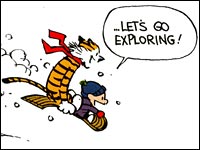
In ending this chapter of this blog, I am reminded of the final instalment of the "Calvin and Hobbes" comic strip, in which Calvin, the boy with a gifted imagination that transforms his stuffed tiger, Hobbes, into a real but friendly tiger with a quick wit, steps outside with his sidekick into a world covered by freshly-fallen snow and exclaims, with toboggan in hand: "Let's go exploring!"

A special welcome to those arriving here at The DIGITAL Archive for the first time and a warm welcome back to my casual/constant readers. This will be a short but important posting, one that will affect the future of The DIGITAL Archive.
After 5 and a half years working in the McGill University Archives, including 2 years working on digitalpermanence (the McGill University Archives' electronic records management and preservation project), I have decided to move on and explore other avenues.
While this marks the end of my time at McGill University (and marks the beginning of a hopefully short unemployment period and a major job search), the future of this blog is not in jeopardy.
It's amazing how this curiously named medium--blog--has given me a new perspective on technology and information, and on the evolution of sharing knowledge and exchanging ideas. It's amazing how bloggers that blog about libraries and archives and digitization and digital projects (and you know who you are) have broadened my horizon.
In a way, thanks in part to their enthusiasm and their daily commitment to post news and observations about the world of digital information, these dedicated bloggers helped me make the decision to move onward.
The decision to leave one's job is never easy, particular when the experience was positive. But sometimes the gut feelings and flashing lights are too strong and persistent to ignore, and the courage to make a tough decision surfaces and propels you forward. By chance, I even bumped into a few blogs about just that, here and here.
"OK, so what about The DIGITAL Archive?" you ask.
The DIGITAL Archive--in name, in URL, in design--will remain as such for now. But I will omit its affiliation to McGill University (actually, it was always ad-hoc and unofficial to begin with). Should readers wish to learn more about the McGill University Archives' digitalpermanence project, I encourage them to visit the University Archives' website.
The content of The DIGITAL Archive will change, however. One thing I've noticed about blogging is that content evolves as the writer begins to grow more confident, more focused, on his or her topic of choice. I would like to track interesting news stories that involve digitization projects, institutional and governmental digitization initiatives, digital preservation, the evolution of the Web, the dissemination of online information, RSS, podcasting, the future of archives and libraries, plus a few personal commentaries and observations, if I can squeeze those in as well.
Consider this blog as my connection to world of digitization. I'll use it to stay current as I embark on my job search into--surprise, surprise--the world of digitization.
I promised to make this posting short, but looks like I blew it.
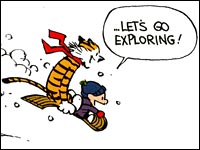
In ending this chapter of this blog, I am reminded of the final instalment of the "Calvin and Hobbes" comic strip, in which Calvin, the boy with a gifted imagination that transforms his stuffed tiger, Hobbes, into a real but friendly tiger with a quick wit, steps outside with his sidekick into a world covered by freshly-fallen snow and exclaims, with toboggan in hand: "Let's go exploring!"

Monday, February 13, 2006
Technical Glitches
In reading The DIGITAL Archive, you may notice that the paragraph formatting has gone haywire.
I was tweaking settings over the weekend (and I suspect I fooled around with things I should not have) and there we go. No more paragraphs, just blocks of text.
Hang in there as we fix this technical difficulty.
I was tweaking settings over the weekend (and I suspect I fooled around with things I should not have) and there we go. No more paragraphs, just blocks of text.
Hang in there as we fix this technical difficulty.
Wednesday, February 08, 2006
Article: The End of the Internet?
Is the Internet as we know (and love) about to come to an end?
The Nation has an eye-opening article.
And just when I was getting used to this Internet thing...
The Nation has an eye-opening article.
And just when I was getting used to this Internet thing...
Wednesday, February 01, 2006
Tuesday, January 31, 2006
The Digital Preservation of Blogs
Many posts ago, I wrote a piece on whether archivists should digitally preserve blogs. I asked whether preserving blogs should be done, and how should archivists go about doing so, if the decision is made to do so?
The Rogue Librarian discusses this issue in a thoughtful manner. Quoting from RL's post:
"How will tomorrow'’s historians understand the development and impact of blogs? What evidence will future researchers turn to when they want to examine the influence that blogs had on Howard Dean'’s 2004 presidential campaign, or how a blog post disgraced 60 Minutes by revealing that what was believed by Dan Rather to be a legitimate memo about George W. Bush'’s military service was a forgery? What primary source material will show that it was a blogger who filed a Freedom of Information Act request and posted 361 snapshots of coffins of solders killed in the US war in Iraq?"
As a history grad, I can appreciate RL's perspective on the historical significance of blogs (as a communicaton and news & information tool as well as a cultural phenomenon).
The Rogue Librarian also mentions that a group of library school students were investigating the technical, social and legal problems posed by the preservation of blogs
Maybe some of you have some thoughts on this?
Monday, January 30, 2006
Google.cn: The Aftermath
In my last post, I talked about Google's presence in China and its decision to censor certain keywords at the request of the Chinese Government.
Andrew McLaughlin, Senior Policy Counsel at Google, wrote a post on January 27, 2006, called Google in China, that argues Google's decision and responds to criticism expressed by the public.
Granted, this and other news items that I have posted lately have no direct connection to digization or McGill's digitalpermanence project.
But I believe that in pursuing digitization and digital perservation we are in fact pursuing improving and increasing access to information now and in the future...something which Google's decision somewhat strays away from.
Wednesday, January 25, 2006
flip-flop.google.com
Is freedom to search and access information on the web in jeopardy?
About a week ago (time passes so quickly nowadays, I'm not even sure), I read that Google had successfully resisted U.S. Government pressure to hand over search query data, which the search engine giant collects. The company earned plenty of praise. Privacy had prevailed.
Now I'm reading a news article in The Register that explains Google's recent decision to tailor its new Google China website to the specifications of the Chinese Government. According to news reports, including an interesting (and revealing) article from China Daily, the Communist government wants Google to self-censor certain keywords that are forbidden under local Chinese laws and policies in order for Google to do business in China's expanding economy and middle class. The China Daily article explains:
"The government bars access to 20 broad content categories, including pornography and other banned material."
While I can understand banning pornography, I wonder about those 20 broad content categories and that nebulous 'banned material.'
However, Google co-founder Sergey Brin considers his company's decision painful but right.
Mind you, Google is not the only Internet company to apply self-censorship. MSN and Yahoo have done the same in order to do business in China, which, according to the latest economic reports, ranks China as the fourth largest economy in the world, right after the United States, Japan, and Germany.
My point in all this, I guess, is: We create content and we upload content to the Web; as professionals we embark on digitization projects to make our collections, books, whatever, more accessible. But then the means to search and find our endeavours is blocked by government censors or search engine filters because the works may contain forbidden material.
The second point: I am surprised at how companies (i.e. Google), for the sake of doing business in a lucrative market such as China's, will sweep some of their guiding principles (i.e. Do not evil) under the proverbial rug.
So, is freedom to search and access information on the Web in jeopardy?
I guess it all depends on the country you live in.
Tuesday, January 24, 2006
Political Winds of Change
On January 23, 2006, Canada elected a new Prime Minister. Stephen Harper, the leader of the Conservative Party of Canada, was voted in as Canada's 22nd Prime Minister. In the House of Commons, his fellow Conservatives will form a minority government, which means Harper and his Cabinet must make alliances with the other political parties (Liberals, New Democratic Party, Bloc Quebeçois, etc) in order to make and pass new policies and laws. It will be will an interesting Parliament, to say the least.
That said, I am interested in learning more about Harper's vision and plans for such areas as universities, academic and research funding and for government agencies such as Canadian Heritage and Library and Archives Canada. His political policies will impact these areas.
Politicians are always dodgy during the campaign - mostly promising the world and the moon and the stars. But with the campaign over, the concrete plans will be unveiled.
As a political agnostic in true Canadian form, I do not believe in one particular political party. They each have their merits. However, I do believe that one political party with at least a decent vision for the country and its institutions, and a commitment to rally the public around the vision, can certainly make a positive difference.
With this vote, Canadians chose not to support the Liberal Party as they had done for the past 13 years and instead put their cautious trust in the Conservatives.
Here's hoping for Canada's continued success.
Monday, January 23, 2006
Predictions 2006: Future Prospects for Librarians and Archivists
This is the third post in my “Predictions 2006” series. The aim is to make some predictions, based on trends, about the future of libraries, archives, Web technologies, electronic records management, digital preservation, etc. I make these predictions with a mix of reflection and spontaneity.
In this installment I will explore the future career prospects for librarians and archivists. I must admit, I had not planned on writing on this topic. But after reading 2 particular news items in the past couple of weeks, and in reading a few blogs that covered the same topic, I felt it important to discuss this matter.
This prediction is not pretty, I should caution. It will force many librarians and archivists, particularly new professionals in the field (like me), to wake up to some hard realities and develop a career strategy to confront and conquer the difficult issues happening now and in the future. However, it is not all doom and gloom, for I also predict that the future is bright (a kind of sunshine bright that shares the sky with scattered storm clouds) as long as librarians and archivists are passionate about a given area in the field and embrace a multidisplinary approach to their profession and are willing to take risks and flex their creative muscles.
A little background...
The first article I read that prompted this post originated from the US News & World Report's website. The article, "Career Center: Excellent careers for 2006," listed the top 10 careers for 2006. Among the top ten was--suprise, surprise--the field of librarianship. Granted, the article did not explicitely mention archivist. However, there are enough similarities to both professions (we both select, organize, retrieve, transmit important information and often, at least in an academic setting, are coupled with libraries) that, for the sake of argument, I will say that archivists and librarians are connected.
Here's an excerpt from the US News & World Report article:
Librarian: This is an underrated career. Most librarians enjoy helping patrons dig up information. They learn in the process and keep up to date on the latest books and online resources. The need for librarians, unfortunately, may decline because search engines make it easy for patrons to find information without a librarian's help. The job growth for librarians will be in nontraditional settings: corporations, nonprofit organizations, and consulting firms.
For me, 2 things popped out at me after reading this:
Among other things, the study revealed:
Librarians complained that there was not enough variety in their work, that they did not have enough control over their careers, and they were not allowed to put their skills to full use. The lack of job satisfaction meant they were more likely than other professions to be absent from work, or to vent their frustration on their families when they got home.
Mr. Saddiq concludes, explaining that "they [librarians] are sick of being stuck between the same shelves of books all day. They also found their work repetitive and unchallenging, and overall had very little job satisfaction..."
Like the first article, something popped out at me after reading this article:
In reading these articles and other people's opinions, and in reflecting on my own personal work experiences, I believe and I predict that the future prospects for librarians and archivists will be, well, it depends. Let me explain.
I went on a conference hosted by the International Council on Archives Section on University and Research Institution Archives (ICA/SUV) last year in September 2005. It was a good friendly crowd of archivists from around the world with different backgrounds and interests ...and with one thing in common: they were underfunded, understaffed, and overworked. This was repeated over and over again to the point where I became frustrated. Ah, frustrated. Frustration over the fact that, though there was much work to be done and many exciting projects to start (e.g. digitization, digital preservation), there was little funding to pursue these projects.
Why so little funding?
The fact is, in our current world, where appearances mean everything, the libraries and archives are perceived as being part of the past, a derelict storage room of aging material and books. It is seen as neutral--what does it contribute?--and as a result not very high on priority lists or budgets.
If this is indeed the wide-spread case, then how does one change the status quo, and what does this mean in terms of future career prospects for librarians and archivists?
To make any change, one must start with the self. To be a librarian or an archivist nowadays, I believe one must have passion. There are many difficult obstacles and plenty of frustrations on the road ahead, so passion--real dedication, not lukewarm woo-hoo--will keep fueling your committment.
It is also important to become an expert or, in other words, find an area in the field in which to dedicate yourself. If you're not feeling this passion, this dedication, then I would suggest you pause and review your options and motives, because this is absoluetely critcal to your future career prospects.
A lot of problems that libraries and particularly archives face revolve around being misunderstood or, worse, institutionally "invisible." What should librarians do in the age of Google? What should archivists do beside carefully shelve boxes of records and priceless artifacts? The days of remaining "mysterious" or hidden are over. It's time to broadcast the real story.
Whatever course of action professionals take to get the message out, there must be a good dose of a multidisciplinary approach included. Multidisciplinary, interdisciplinary, call it what you like, but in universities and for acadmics this is the future. Why not say the same for librarians and archivists? Just like no man is an island, no librarian or archivist is one either. Cooperation, collaboration, and relationships are essential. Making a library or archives part of a larger body of study, research, or community involvment is paramount.
A question to consider: Should Google replace librarians? Of course not, no! Sounds like a simple question whose answer is a given. But truth is, the answer is not on the tip of everyone's tongue. Another question: Should an archivist be content with having his or her collections sit on a shelf? No! Collections are meant to be shown, and today's technology makes it possible (and relatively inexpensive) to do so.
It's all about not assuming anything, and being proactive in everything.
In short, I predict the future career prospects of librarians and archivists in 2006 will be (using this addictive weather analogy of mine) sunny with cloudy periods.
To burn away those excess clouds, I suggest that the new librarian or archivist entering the profession should be:
The key to making this job still one of the "most excellent" careers is embracing your opportunities and minimizing the drawbacks. If you need a change in libraries scenes to increase your opportunities then so be it. Change is scary but it is also a good thing. Any job could be classified as boring. Any job is what you make of it.
Well said! Embracing your opportunities and minimizing the drawbacks or taking a risk and changing directions if opportunities present themselves elsewhere. Now that is the future of the library and archives profession. Good luck!
In this installment I will explore the future career prospects for librarians and archivists. I must admit, I had not planned on writing on this topic. But after reading 2 particular news items in the past couple of weeks, and in reading a few blogs that covered the same topic, I felt it important to discuss this matter.
This prediction is not pretty, I should caution. It will force many librarians and archivists, particularly new professionals in the field (like me), to wake up to some hard realities and develop a career strategy to confront and conquer the difficult issues happening now and in the future. However, it is not all doom and gloom, for I also predict that the future is bright (a kind of sunshine bright that shares the sky with scattered storm clouds) as long as librarians and archivists are passionate about a given area in the field and embrace a multidisplinary approach to their profession and are willing to take risks and flex their creative muscles.
A little background...
The first article I read that prompted this post originated from the US News & World Report's website. The article, "Career Center: Excellent careers for 2006," listed the top 10 careers for 2006. Among the top ten was--suprise, surprise--the field of librarianship. Granted, the article did not explicitely mention archivist. However, there are enough similarities to both professions (we both select, organize, retrieve, transmit important information and often, at least in an academic setting, are coupled with libraries) that, for the sake of argument, I will say that archivists and librarians are connected.
Here's an excerpt from the US News & World Report article:
Librarian: This is an underrated career. Most librarians enjoy helping patrons dig up information. They learn in the process and keep up to date on the latest books and online resources. The need for librarians, unfortunately, may decline because search engines make it easy for patrons to find information without a librarian's help. The job growth for librarians will be in nontraditional settings: corporations, nonprofit organizations, and consulting firms.
For me, 2 things popped out at me after reading this:
- The need for librarians will decline because search engines make it easier for patrons to find information;
- Job growth will occur in nontraditional settings: corporations, non-profit organizations, consulting firms
Among other things, the study revealed:
Librarians complained that there was not enough variety in their work, that they did not have enough control over their careers, and they were not allowed to put their skills to full use. The lack of job satisfaction meant they were more likely than other professions to be absent from work, or to vent their frustration on their families when they got home.
Mr. Saddiq concludes, explaining that "they [librarians] are sick of being stuck between the same shelves of books all day. They also found their work repetitive and unchallenging, and overall had very little job satisfaction..."
Like the first article, something popped out at me after reading this article:
- Despite the lack of detailed information on those surveyed, the article boils down the situation of librarians to this: it is unglamorous, unappreciated, and therefore stressful
In reading these articles and other people's opinions, and in reflecting on my own personal work experiences, I believe and I predict that the future prospects for librarians and archivists will be, well, it depends. Let me explain.
I went on a conference hosted by the International Council on Archives Section on University and Research Institution Archives (ICA/SUV) last year in September 2005. It was a good friendly crowd of archivists from around the world with different backgrounds and interests ...and with one thing in common: they were underfunded, understaffed, and overworked. This was repeated over and over again to the point where I became frustrated. Ah, frustrated. Frustration over the fact that, though there was much work to be done and many exciting projects to start (e.g. digitization, digital preservation), there was little funding to pursue these projects.
Why so little funding?
The fact is, in our current world, where appearances mean everything, the libraries and archives are perceived as being part of the past, a derelict storage room of aging material and books. It is seen as neutral--what does it contribute?--and as a result not very high on priority lists or budgets.
If this is indeed the wide-spread case, then how does one change the status quo, and what does this mean in terms of future career prospects for librarians and archivists?
To make any change, one must start with the self. To be a librarian or an archivist nowadays, I believe one must have passion. There are many difficult obstacles and plenty of frustrations on the road ahead, so passion--real dedication, not lukewarm woo-hoo--will keep fueling your committment.
It is also important to become an expert or, in other words, find an area in the field in which to dedicate yourself. If you're not feeling this passion, this dedication, then I would suggest you pause and review your options and motives, because this is absoluetely critcal to your future career prospects.
A lot of problems that libraries and particularly archives face revolve around being misunderstood or, worse, institutionally "invisible." What should librarians do in the age of Google? What should archivists do beside carefully shelve boxes of records and priceless artifacts? The days of remaining "mysterious" or hidden are over. It's time to broadcast the real story.
Whatever course of action professionals take to get the message out, there must be a good dose of a multidisciplinary approach included. Multidisciplinary, interdisciplinary, call it what you like, but in universities and for acadmics this is the future. Why not say the same for librarians and archivists? Just like no man is an island, no librarian or archivist is one either. Cooperation, collaboration, and relationships are essential. Making a library or archives part of a larger body of study, research, or community involvment is paramount.
A question to consider: Should Google replace librarians? Of course not, no! Sounds like a simple question whose answer is a given. But truth is, the answer is not on the tip of everyone's tongue. Another question: Should an archivist be content with having his or her collections sit on a shelf? No! Collections are meant to be shown, and today's technology makes it possible (and relatively inexpensive) to do so.
It's all about not assuming anything, and being proactive in everything.
In short, I predict the future career prospects of librarians and archivists in 2006 will be (using this addictive weather analogy of mine) sunny with cloudy periods.
To burn away those excess clouds, I suggest that the new librarian or archivist entering the profession should be:
- Passionate
- Dedicated to an area, be it public libraries, digital libraries, digital archives, etc
- Confident and capable in dealing with workplace frustrations, particularly funding frustration
- Multidisciplinary, that is, forming relationships and integrating into other fields
- Creative
- Risk-Taking
The key to making this job still one of the "most excellent" careers is embracing your opportunities and minimizing the drawbacks. If you need a change in libraries scenes to increase your opportunities then so be it. Change is scary but it is also a good thing. Any job could be classified as boring. Any job is what you make of it.
Well said! Embracing your opportunities and minimizing the drawbacks or taking a risk and changing directions if opportunities present themselves elsewhere. Now that is the future of the library and archives profession. Good luck!
Wednesday, January 18, 2006
Worldwide E-Gov Initiatives Huge: Is digital management and preservation ready?
Federal Computer Weekly (FCW) is both a magazine and a web publication that covers IT and IT-related news affecting the US Government's information technology infrastructure. Overall, it's an interesting read, for the most part.
FCW.com hosts 2 blogs, one of which, called Culture and Context, had a post that discussed the growing size of e-government--in this case, the number of webpages operated by governments worldwide.
With a whopping 368 million webpages, the US Government e-gov has the most number of webpages, followed by its little brother, and my home and native land, Canada with 12 million webpages.
I hope someone's considering the electronic records management issues here (which webpages should be kept?), as well as electronic preservation issues (which webpages should be archived for posterity, and how?).
The top ten largest e-gov initiatives (in terms of number of webpages) are available on said blog and as part of a larger research [PDF] project published by the Electronic Government journal.
It's wet, it's icy, it's a mess!
 From time to time, The DIGITAL Archive is affected by things beyond its control. Today, the weather is the culprit.
Late last night, the island of Montreal--no stranger to strange weather--experienced freezing rain, straight rain, and then more freezing rain. Taken together (and add in a mix of little or no street salting or cleaning), and Wednesday morning started off on a rather slippery note.
So I am writing this post from the comfort of my warm and dry abode.
Photo: This house's roof has a patch of snow encased in a layer of ice.
UPDATE: The weather continues to be, in the words of mostly all radio announcers on both English radio stations (CJAD, CINW) in Montreal, absolutely miserable.
UPDATE 2: The streets surrounding McGill University are closed due to icy conditions and flooding. The campus is located at the base of Mont Royal. Flooding + Archives = Not Good
Sunday, January 15, 2006
News: EU countries to build digital library to rival Google
From China's People's Daily Online (yes, I read 'em all):
Jean-Noel Jeanneney, Curator of French National Library, told media that European libraries would digitalize 50,000 to 60,000 books by the end of 2006 and the construction of the program would be in full gear in 2007. France promised to digitalize at least 15,000 books and fund 15 million euros a year.
News: Library of Congress to store records, movies in Cold War-era vault
According to Federal Computer Weekly (FCW.com), the Library of Congress will move 2.7 million sound recordings and 1.1 million moving images to a former Federal Reserve atomic bomb shelter and subsequently digitize them.
The article, Library to store records, movies in Cold War vault, talks about digital preservation of audio and moving images.
The article, Library to store records, movies in Cold War vault, talks about digital preservation of audio and moving images.
Friday, January 13, 2006
Predications 2006: The Desktop and the Web
This is the second post in my “Predictions 2006” series. The aim is to make some predictions, based on trends, about the future of libraries, archives, Web technologies, electronic records management, digital preservation, etc. I make these predictions with a mix of reflection and spontaneity.
In today’s installment I explore the ways in which local desktop applications and the Web are slowly intertwining, thus shrinking the gap that exists between local desktop applications and the World Wide Web, which I believe will lead to a greater, more personalized and more relevant desktop/Web experience.
In 2005, I encountered several web tools and software that had me buzzing with excitement, chief among them was Mozilla’s Firefox browser and its myriad of extensions. Near the end of 2005 I downloaded Google’s Blogger for Word (and made mention of it here and here) in addition to Google’s Blogger Web Comments. Taken together, I noticed how these tools and application were changing the desktop landscape.
For those not familiar with the items I mentioned, here’s a brief summary:
Firefox: If you haven’t heard about Firefox, well, er…Firefox is an amazing Web browser, made even more amazing by a vast amount of extensions that literally extend the browser’s power. Popular extensions include ForecastFox, a weather forecast extension, Sage, a RSS reader, and Blogger Web Comments (which I’ll discuss shortly). What I like about these particular extensions is that, while I am browsing, they are busy working, pulling information that I want—be it weather information, stock quotes, or who’s blogging about my blog—and displaying them when I want.
Blogger for Word: A plug-in, so to speak, for Microsoft Word, developed by Google, that enables bloggers to write and submit their posts to Blogger while still in Word. By no means an earth-shaking tools, Blogger for Word nonetheless revealed to me the shrinking space between my desktop application and the Web.
Blogger Web Comments: A nifty Firefox extension that fetches blog-based information related to any webpage you visit. In visiting The DIGITAL Archive blog site with Blogger Web Comments enabled, for example, I discovered (ahh, the joy of discovery) that two blogs had mentioned my blog in their postings. So, naturally, I visited their blogs, found them interesting, and added them to my list of sites to visit. Like other Firefox extensions, Blogger Web Comments was busy fetching information while I was browsing; and when I needed the info, it gave it to me.
I’m not sure if there is a proper technical term for these kinds of tools. I call them Firefox extensions, plug-ins, and Web apps, among other names. Even Yahoo has entered the field with its selection of Yahoo! Widgets, slick-looking desktop tools (like Apple’s Dashboard Widgets) that fetch information and display them on your desktop, like weather updates, stock quotes, etc. Whatever the case, these tools are joining our local desktop with the Web in a manner not seen before.
I believe local desktop applications and the World Wide Web will come together and collaborate in new and more advanced ways in the coming year. The space between them is clearly shrinking. I see the every day tools we work with, such as Microsoft Office, and our Web destinations of choice, such as Google and Amazon.com, working together (ok, maybe not Microsoft and Google, but you get the picture).
We users will easily set up mechanisms within desktop applications that allow us to set search queries, security parameters, and then launch intelligent “boomerangs” or agents that will swoop to web resources and re-combine data and return to us, providing us with relevant information.
Today it’s weather forecasts and stock quotes on our desktops; tomorrow it could be a window in Microsoft Word opening and alerting us to the latest news and views on the topic of our research paper.
Thursday, January 12, 2006
News: NARA's Electronic Records Archive project
Rather than a simple article on National Archives and Records Administration's Electronic Records Archive project, Wired takes the view that the human touch--fundamentals of archival knowledge and skills--is still required even when dealing with electronic records.
Wired 14.01: POSTS
Wired 14.01: POSTS
Saturday, January 07, 2006
Should we Preserve Blogs (or are blogs worth preserving in the first place)?
The DIGITAL Archive would not be called The DIGITAL Archive if it did not address the issue of digital preservation, right?
In light of my recent postings on blogging and its future, I wonder if institutions, corporations, and other organizations that actively use blogs to communicate with colleagues, clients, and customers should prepare policies that dictate how these blog postings--these electronic records of communication--should be managed to comply with existing retention policies and preserved for historical purposes?
Blog Archiving? Currently, there are several projects attempting to archive websites. I wonder if we should treat blogs as just another website: to be captured and archived and made accessible. Or should we treat blogs as something more?
Further thoughts on Blogging
Continuing on the topic of blogging and its future, I read an interesting post by Irving Wladawsky-Berger called Reflections on Blogging.
Friday, January 06, 2006
THE Journal askes "Why Blog?"
Considering my Predictions 2006 on Blogs yesterday, here is an article to read:
Why Blog? : December 2005 : THE Journal
Why Blog? : December 2005 : THE Journal
Wednesday, January 04, 2006
Predictions 2006: Blogs and Beyond
This is the first post in my “Predictions 2006” series. The aim is to make some predictions, based on trends, about the future of libraries, archives, Web technologies, electronic records management, digital preservation, etc. I make these predictions with a mix of reflection and spontaniety.
Today, I’ll make a prediction on blogs (since the DIGITAL Archive is a blog, it’s a great place to start).
Back in the mid-1990s, while I was a student in university, there was something that every Web-savvy person I knew had: a personal homepage. Remember those? They were basic HTML web pages with text (usually about the author of the web page), a few pictures (usually of the author and his or her family members and pets), some animated GIFs here and there, plus a few hyperlinks to other web pages, usually of friends that had a homepage as well. I made a few personal homepages. I think we all made a few personal homepages back then.
Homepages were fun and relatively easy to make once one had learned a few basic HTML tags. The author simply had to set up a few tables (border=”5”, typically), then write up some text, post a few pictures, add a few hyperlinks, upload the HTML file to a server, and—voila!!—one had a genuine presence on the World Wide Web.
Fast-forward to 2003, when I first encountered a weblog (or blog, the swampy-sounding name derived from the original term). Initially, the blog seemed to me like another web by-product --essentially, another version of the ubiquitous personal homepage.
But once I started dabbling with Blogger (a free online blogging website) in 2004 (and others, like WordPress, more recently), I realized the blog was clearly more than a personal homepage. First off, a blog did not require extensive knowledge of HTML. It was a publishing and content management tool for the masses, a venue where personal thoughts can be shared with the public, where knowledge shared can become collaborative efforts, and where shared interests can form relationships.
Personal homepages and blogs do have one thing in common: They both contain content created or linked by a user. And it is this common ground—content—which I believe can help shed light on the future of blogs.
Over the years, personal web publishing platforms have evolved, from personal homepages (geocities.com, for example) to personal blogs (Blogger.com, for example), and I predict this trend will continue, this time evolving from personal blogs to networked blogs—a thinking blog, basically—one where content becomes more meaningful to other blogs and users and is more easily discoverable by search engines.
The future of the blog, I believe, will be about making the user's content more powerful, more searchable, more meaningful, more proactive to create a more personal blog experience. We already see some of this with blogs and RSS feeds. Blog updates are pushed to RSS feed subscribers. The contents of a blog are not static, sitting around waiting for something to occur; they are active and will become more active, triggered manually by users or by advanced search queries and more powerful RSS features.
Blog platforms will change (perhaps even renamed), but the clearer communication of content (of ideas, information, thoughts, comments, opinions), from author to reader, will be at the forefront in the coming year.
Tuesday, January 03, 2006
Predictions 2006
Over the holidays, I listened to a late-night radio talk show called Coast to Coast AM hosted by Art Bell. A number of years ago (back in the late 90s, I’d say), Art Bell was one of the hottest personalities on syndicated radio.
With an investigative style of his own design, Art Bell discussed UFOs, government cover-ups, science, pseudo-science, and conspiracy theories with an eclectic mix of guest experts and enthusiastic callers. Art Bell was seriously entertaining and hugely popular. However, while his popularity soared, personal and family matters forced him to retire.
But as the saying goes, “You can’t keep a good (radio) man down,” and so Art Bell, after numerous radio disappearances and re-appearances, returned to the airwaves, where he now hosts a weekend version of his show Coast to Coast AM.
This past weekend, his year-end show was all about predictions. He asked his callers to use their intuition and innate psychic powers to predict future events.
It was all in good fun (although a few prognosticators did offer some dire visions of future events). In the end, I thought to myself: “Uhhmm, sounds like a fun topic to blog about.”
Over the next couple of days, then, I will post some of my personal predictions for the upcoming year as they relate to the future of libraries, archives, Web technologies, electronic records, digital preservation and whatever else my “psychic twinkle” offers up to me. And I want to encourage readers to comment and/or post some of their predictions as well. What do you think will be the next big thing? Will digital preservation take a giant leap forward? Will Google take over the world?
Have a happy new year!!
Friday, December 23, 2005
Seasons Greetings from the DIGITAL Archive
We here at the DIGITAL Archive would like to wish all our readers a very Merry Christmas and a Happy New Year.
Celebrate this holiday season - we made it this far, why not sit back, relax, and enjoy.
Besides these warm wishes, I'm tossing in a Christmas gift for you readers that will last all year round, thanks in part to Flickr, the Web's best online photo sharing site, in my opinion.
Scroll down the main page and keep your eyes to the right (if you're reading this via a RSS news reader, please visit this page). You'll notice a Flickr flash gallery with images of the McGill campus (taken by various McGill amateur photographers) fading in and out in random sequences. It's a mini photo gallery with a twist. No batteries needed.
Tuesday, December 20, 2005
Web Archiving
I can't believe I forgot to mention a significant development in regards to our digitalpermanence initiative.
A few weeks ago, our dp team viewed a piece of software, which was developed by a Ph.D student here at McGill, that captures dynamically-generated webpages such as the McGill University website.
The McGill University website includes both static webpages (HTML webpages that have text and graphics) and dynamic webpages (HTML webpages whose contents reside in a database and are populated upon a page request).
It's easy enough to capture static webpages with freely-available software (e.g. HTtrack); however, it's another story entirely to capture websites that are both static and dynamic.
The software that was developed can capture static webpages in XHTML and capture database content and package it into XML. It is hoped that we can tie both the XHTML and XML together and create a seamless web archive of our McGill website. That's the plan.
I'll post more as further details and new developments emerge.
Tagging Emails
In the New Year, the dp team is hoping to launch a small pilot project in collaboration with the university's IT sector. The project will focus on finding ways to classify emails in order to separate business emails from non-business emails and append retention rules so that they can be managed properly and those of long-term value be preserved for future researchers.
For classifying or organizing email inboxes, we're considering 2 approaches:
This pilot project is in fact a research project. We'll be testing and analyzing hard results. We'll audit email records users send us. And we'll move forward from there, correcting what doesn't work and enhancing what does.
This is our first foray into a concrete email management program. We are not considering an enterprise-wide email management software solution just yet. We really want people on campus--staff, faculty, administrators--to begin to think a little differently about emails and electronic correspondence, to see them as equally valuable as paper memos from days gone by.
It's about change management first. Then it's about email management.
For preserving emails (the big long-term issue), we're considering converting emails to XML. With its structured appearance, emails seem to be a perfect fit for XML. According to some of the university technologists I spoke with, there should be not much trouble in converting emails to XML, at least technically speaking. The real issue is to make sure the right emails (i.e. the classified emails) are preserved and transferred to the university archives' planned long-term storage servers, while the junk, the miscellaneous, the spam are deleted permanently.
For classifying or organizing email inboxes, we're considering 2 approaches:
- Create new folders and sub-folders in user's inbox into which they click and drag business emails into appropriate folders;
- Adopt a tagging approach in which users tag or label emails with business value with distinct terms such as Personnel, Financial, Student, etc.
This pilot project is in fact a research project. We'll be testing and analyzing hard results. We'll audit email records users send us. And we'll move forward from there, correcting what doesn't work and enhancing what does.
This is our first foray into a concrete email management program. We are not considering an enterprise-wide email management software solution just yet. We really want people on campus--staff, faculty, administrators--to begin to think a little differently about emails and electronic correspondence, to see them as equally valuable as paper memos from days gone by.
It's about change management first. Then it's about email management.
For preserving emails (the big long-term issue), we're considering converting emails to XML. With its structured appearance, emails seem to be a perfect fit for XML. According to some of the university technologists I spoke with, there should be not much trouble in converting emails to XML, at least technically speaking. The real issue is to make sure the right emails (i.e. the classified emails) are preserved and transferred to the university archives' planned long-term storage servers, while the junk, the miscellaneous, the spam are deleted permanently.
Saturday, December 17, 2005
Storm Hits the DIGITAL Archive

My scheduled blogging was interrupted by Montreal's first snowstorm of the season. And was it ever a big snowstorm! According to Environment Canada, Montreal received 40cm (15 inches) of snow, almost beating the record set in 1971, which was 43.2 cm (what's a few centimetres among friends, really).
Friday morning, December 16, I woke to see that the world of 'snow and grass patches' from the day before had transformed into a one giant snow covered mound. One person explained the snowstorm in the best possible way:
You know those snow globe toys? The ones where a miniaturized city scene or landscape is placed inside a plastic dome-shaped casing that is filled with a liquid and tiny white, sparkling flakes. Upon shaking the globe, the entire scene is blotted out by the 'snow.' Well, picture that and then picture knee-high snow, pedestrians walking in the middle of the road, cars on the highway stuck in traffic, etc. And you get a pretty good picture...if not, check out the pic accompanying this post.
Thursday, December 15, 2005
Who else is out there?
I believe that blogging is all about communicating and connecting with people who share your interests. One can find an amazing blog filled with some great content by searching feverishly or sometimes by sheer luck. I've been fortunate enough to come across a few good ones--and I'm always on the lookout for more.
In searching for and reading blogs about electronic documents/records, digital preservation, digitization projects, technology etc, I've noticed a nice trend among bloggers: people making mention of the blogs that they read, listing them, describing them, and including their URL. This is great. The search for relevant blogs becomes all the more easier.
So without further ado, here's a list (in no particular order) of the blogs that I find interesting:
- The Ten Thousand Year Blog (by David Mattison) - I don't know how Archivist-Historian David Mattison does it, but he pulls together a wealth of digital preservation and digital culture information pretty much every single day. I subscribe to his RSS feed.
- Digitization 101 (by Jill Hurst-Wahl) - Another content-rich, all things digital blog run by Jill Hurst-Wahl, who runs a digitization consultant service company called Hurst Associates. Very good quality stuff. I subscribe to her RSS feed.
- digitization (Mark Jordan) - Another great blog that nicely packages news and information on digitization, electronic publishing, and digitization projects. Always a posting worth reading. I subscribe to his RSS feed.
- ::schwagbag:: (Sherri Vokey) - Sherri is "a tech-inspired and Mac-lovin' librarian who offers up a daily (well, mostly) dose of library and technology related miscellany." What I like about Sherri's blog is that she combines her work experiences and love of technology in one cool package. I subscribe to her RSS feed.
- The Shifted Librarian (Jenny Levine) - Jenny's blog reflects her belief that librarians ought to shift and embrace current and emerging technologies in order to truly serve tomorrow library patrons. I agree, and that's why her blog is of interest: she posts lots of information on new technologies--cool tools--and how they enhance the librarian/information professional's career and service. I subscribe to her RSS feed.
- I Like Dust (Lindsey) - A newly discovered blog, I Like Dust chronicles the career aspirations of an archivist in training, Lindsey. (Word of advice from someone working in a university archives, inhaling dust is not good ;). I subscribe to her RSS feed.
- Preserving the digital (Mnemosyne) - I recently came across this blog. Just started reading it. I subscribe to his/her RSS feed.
Wednesday, December 14, 2005
Knock, knock, knocking on IT's Door

Our dp team had a meeting with the McGill University's IT director. The meeting went pretty well, in my opinion. We put forward our concerns--chiefly among them, email management--and recommended some concrete solutions, such as classification schemes, which had been fleshed out and made into a clear Visio diagram.
In turn, the IT director, as a sign of his understanding and willingness to cooperate further, offered resources (mainly human, for now) and the novel idea of tagging emails for classification purposes. Sounds like a good start to something hopefully bigger.
I'm hesitantly glad things turned out like this. Hesistant? Well, let's hope this small but concrete pilot project gets legs and moves forward. It's been a long long time since we had such a opportunity.
Blogger for Word works...sort of (Off Topic)
Using Blogger for Word worked OK. I still have to figure out some functions (or maybe Google ought to clarify its tool a little)….and figure out why I receive an error message yet my message still posts here - in draft mode.
Anyone else blogging using this tool?
Anyone else blogging using this tool?
Using Blogger for Word (Off-Topic)
Testing new technology is always fun. So now that I have the chance to try Blogger for Word by Google, let’s see how it works.
If all goes well, this little post, which I am writing using Word 2003, will soon appear in this blog.
If all goes well, this little post, which I am writing using Word 2003, will soon appear in this blog.
Tuesday, December 13, 2005
Email Management Migraines
The digitalpermanence (2.0) initiative is looking at emails and email management and preservation.
Nowadays, it's becoming increasingly clear that emails are replacing office memos as the primary means of distributing institutional policies and procedures. Of course, the paper memos still exist. But the reality is that records of transaction are being carried out via email.
As records managers and archivists, how do we deal with this?
Our dp team has come up with, and will be proposing, the following plan: the development and implementation of a classification scheme, built within an email client as a set of folders and sub-folders. We want administrative staff to become more cognizant of the role emails have in conducting official business. Our plan is to have staff file their business emails in email folders and apply rules to folders so that emails are eventually moved to their appropriate spot.
For preservation purposes, our plan is to migrate emails from their native file format to a file format that is not dependent on a particular application. One such file format that comes to mind is XML.
The problems arise when so many disciplines and departments are required to be part of the overall solution. It's very difficult to get everyone at the table on the same page.
Is anyone else out there tackling the email management issue? I'm getting a headache.
Tuesday, October 18, 2005
digitalpermanence 2.0: Re-focused
It's no secret that, when dealing with electronic records and digital preservation, the problems one encounters start getting bigger and more complex. Indeed this truth has affected our digitalpermanence project. For one thing, the ambitious goals and plans we had initially were slowly (but, in a way, thankfully) subdued once the light of reality hit them. What started as a large-scale, campus-wide, "calling all electronic records" project has now been chiseled down and re-focused to a more palpable series of projects.
The University Archives digitalpermanence team has done many wonderful and amazing things in such a short period of time. Since January 2004, the dp team has combed the campus, examining both large and small offices and faculties, and took a thorough inventory of the extent and types of electronic records created on campus.
While our work was successful, and the results of tremendous value, now is the time to focus on electronic records projects that are relevant to the university community. We are now focusing our efforts on immediate campus needs: enterprise data, email management, and document imaging.
I think it's better this way: better for the project and for the people involved. The goal is to accomplish something more concrete, something applicable to the university community, something, in short, that will have an impact on the university.
Stay tuned. digitalpermanence 2.0 is moving ahead.
Tuesday, September 27, 2005
digitalpermanence ICA/SUV Presentation is Here
Okay, so I reckon you've all been wondering about the digitalpermanence presentation that the McGill University Archives gave at the Annual ICA/SUV Conference, which took place between September 6 and 9 in East Lansing, Michigan.
Sure you have. You've been emailing me again and again...
Okay, here's the PowerPoint presentation. Enjoy.
Sure you have. You've been emailing me again and again...
Okay, here's the PowerPoint presentation. Enjoy.
National Archives Names Lockheed Martin to Build Archives of the Future
It's amazing how Lockheed-Martin, the chosen company, which is part of the U.S. military-industrial complex, is now in the business of designing hardware to preserve electronic records. It's an ambitious and well-funded project - so who knows! It's a start, at least.
Saturday, August 27, 2005
digitalpermanence at the ICA/SUV conference
The McGill University Archives will be giving a presentation on its electronic records management project (digitalpermanence) at the next International Council on Archives -Section on University and Research Institution Archives (ICA-SUV) conference to be held between September 6 and 9, 2005 on the campus of Michigan State University in Lansing, Michigan.
At the session entitled Electronic Records Management (September 7 at 10:30AM), we will present our digitalpermanence project and results (thus far). The other presenter on hand Eliot Wilczek from Tufts University. The moderator will be Roland Baumann from Oberlin College.
Once the conference is finished, I'll post the presentation here.
Tuesday, July 12, 2005
Digitization 101: Preservation, Archives and Records, Oh, My!
An interesting item on preserving digital information for posterity.
Digitization 101: Preservation, Archives and Records, Oh, My!
Digitization 101: Preservation, Archives and Records, Oh, My!
Friday, June 24, 2005
The Shifted Librarian: Why RSS and Folksonomies Are Becoming So Big
The Shifted Librarian: Why RSS and Folksonomies Are Becoming So Big
I'm noticing something very surprising with my Web search habits: I'm not using Google as often as I used to. The shock. The horror.
Nowadays, I'm using RSS, blogs, delicious, and other communication and information sharing tools that allow my peers and colleagues to discover and share information among interested community members.
Wednesday, June 22, 2005
McGill 'Gateway' website implements RSS
The other day, while browsing the Web with Firefox, I arrived at the McGill University gateway webpage. I was surprised to see that Firefox's LiveBookmark feature lit up like a Christmas tree. It had found a RSS feed.
A RSS feed on the McGill University gateway webapge?
Yes, it's true. I think this implementation is great. The database-driven content that the system pushes out normally appeared in little system built modules. Now that same content, while still available in the usual system modules, is available as an RSS feed.
Kudos to the Web Services Group, the McGill unit behind the McGill gateway system.
Tuesday, May 31, 2005
Monday, May 30, 2005
digitalpermanence: Transfer and Access Protocols document available
The McGill University Archives has written a discussion document called digitalpermanence: Transfer and Access Protocols (electronic records) [PDF, 337KB] in an effort to develop the procedures for the transfer of and access to McGill University's institutional electronic records.
This document, which took shape after the University Archives’ electronic records campus-wide inventory in 2004, introduces McGill stakeholders, as well as a general audience, to the proposed strategies, methods, and mechanisms for transferring, accessing, managing and preserving electronic records in a digital environment at McGill. It also highlights the activities the McGill University Archives is pursuing in managing and preserving such electronic records as email and websites.
Moreover, the document is meant to build upon the existing research carried out by institutions and organizations around the world involved in managing electronic records and, in turn, to stimulate discussion within the records management and archival communities. Download the document now.
Wednesday, May 25, 2005
The Software is Out There!
Like the tag line from "The X-Files" that appears right after the opening credits, I believe the software to manage electronic institutional records is out there. Perhaps it's a gleam in someone's eye or being coded as I type, but the fact is such a tool must be under development.
All that to say, I came across this post from Jill Hurst-Wahl on her "Digitization 101" blog. She mentions a product called ArchivalWare by PTFS. I haven't taken a closer look yet, but anything related to the concept of storing, accessing and managing digital assets is worth posting here.
Digitization 101: ArchivalWare
Monday, May 23, 2005
Florida Center for Library Automation-Digital Archive
It's important to take note of other digital management and digital preservation projects occurring around the world. Here's one from Florida.
Florida Center for Library Automation-Digital Archive
Florida Center for Library Automation-Digital Archive
Thursday, May 19, 2005
News and Reviews: 'Metadata for Information Management and Retrieval', Ariadne Issue 43
Yet another news iteM, this one on metadata:
News and Reviews: 'Metadata for Information Management and Retrieval', Ariadne Issue 43
News and Reviews: 'Metadata for Information Management and Retrieval', Ariadne Issue 43
Main Articles: 'Digital Preservation: Best Practice and its Dissemination', Ariadne Issue 43
A news item on digital preservation:
Main Articles: 'Digital Preservation: Best Practice and its Dissemination', Ariadne Issue 43
Sigh...I wish blogger had a post classification system...
Main Articles: 'Digital Preservation: Best Practice and its Dissemination', Ariadne Issue 43
Sigh...I wish blogger had a post classification system...
Tuesday, May 17, 2005
DP Protocol Document Coming Soon
For the past couple of months, I've been working on a major digitalpermanence document entitled "digitalpermanence: transfer and access protocols for electronic records."
As the title suggests, this document is intended to establish procedures to enable the transfer and access of electronic records. It is a formidable document, if I do say so myself. I hope once it is released that it will generate some productive commentary.
Stay tuned.
As the title suggests, this document is intended to establish procedures to enable the transfer and access of electronic records. It is a formidable document, if I do say so myself. I hope once it is released that it will generate some productive commentary.
Stay tuned.
Tuesday, May 03, 2005
The Secuity of PDF documents and the US Military
The US military recently published a report on the accidental shooting of an Italian journalist and her secret service bodyguard in Iraq.
In an attempt to conceal names, places, and operational tactics, the US military redacted, or blacked-out, portions of the PDF document using what I believe to be some kind of black highlighter tool available in the Adobe Acrobat application. While I'm not exactly sure about the methods the military used to black out the text, the purpose was clear: to keep some information classified.
Unfortunately, the text beneath the blacked-out sections was in fact viewable. A simple copy-and-paste of the source PDF document to a word processing application like MS Word and--voila!--the hidden text becomes viewable. So much for secrecy!
The US military admits it goofed. And with technology being as complex software as it is, I can't blame the military staffers who bungled the dissemination of this report.
According to PDFzone's David Coursey, this whole mess could have been avoided if only precautions and the investment in proper plug-in software were made. It's a great article. Read it here.
I know several people who simply love PDF: it's convenient, quick, and online dissemination is a snap. But, as records managers and archivists in the digital age, let's not be dazzled by technology without making sure it keeps confidential electronic records safe and secure.
The US military's goof-up is our wake-up.
UPDATE: The fine site Boing-Boing ("A Directory of Wonderful Things") has a posting about this story.
UPDATE 2: An Italian blog/website has the actual military document on view!
Subscribe to:
Posts (Atom)


